
A halal mark should explain how approval was reached
Consumers seeking halal food now have more choices. Halal restaurants are opening across the country, changing communities where halal dining was once hard to find. Products once found mainly in small neighborhood markets now appear in university dining halls, mainstream grocery stores, airport cases, and prepared-food counters. This growth can help Muslim consumers feel seen and make halal choices easier.
But as the market grows, labels can spread faster than the public information behind them. A halal mark tells a shopper that an organization approved a product. On its own, it does not explain how that approval was reached or who was responsible for it. A label does not by itself disclose the method, evidence, qualifications, halal-specific assessment, religious review, or certification authority behind the decision.
The basic rule is clear: a kosher certificate is not a halal certificate, and a kosher audit is not a halal audit. A kosher audit cannot satisfy or replace the halal-specific audit, religious review, and accountable certification decision needed before a product is called halal. The two systems overlap in some areas, but kosher wine shows why they are not automatically equivalent: wine may be kosher while alcohol remains prohibited in halal [31] [34] [36].

Who Etimad Halal is
Etimad Halal operates publicly as Etimad, LLC, a halal compliance and certification company using a Dover, Delaware business address. Its domain was registered on July 16, 2018. An archived Etimad page records the company’s public position by May 2021, and independent reporting identifies Etimad as the halal certifier for Ithaca College’s Kosher Korner in April 2022 [23] [24] [25] [32]. The reviewed sources do not establish Etimad’s exact founding date.
Etimad’s current website says it was created to make halal certification more accessible and describes a network of halal certification bodies [25]. Its certification activity can be independently seen: client certificates name Jamal Saleem as Halal Administrator, and New York’s official halal-establishment registry lists Etimad as the certifier for a university kosher station [21] [22]. These records show certification activity and the repeated use of an administrator’s name. They do not disclose Etimad’s owners, governing personnel, auditor qualifications, religious-review authority, or certification-decision structure. USDHS accreditation eligibility requires verified 100% Muslim ownership. Etimad is not verified as 100% Muslim-owned and therefore does not meet the USDHS ownership eligibility requirement on the present record. This does not find that the unknown owners are non-Muslim; it finds that the required ownership has not been proved [49].
EarthKosher is an Orthodox kosher certification agency founded in 2004 and publicly based in Boulder, Colorado [33]. In July 2026, Etimad and EarthKosher announced a combined program promising no duplicate audits or added site visits [27]. Original Fresko product photographs also show Etimad’s halal mark beside several kosher marks on prepared meat products. The question is not whether the labels exist or whether Etimad conducts real certification work. The question is whether the public record shows a complete halal audit that remains separate from the kosher audit, and who was accountable for that work.
Halal Industry Exposé · Comprehensive Accountability Assessment
Etimad Halal Organizational accountability and public certification-criteria disclosure: 31% Credibility Score · Grade F · Insufficiently substantiated
Moderate confidence. Etimad Halal receives a 31% Credibility Score (Grade F). This review could not verify qualifying current independent accreditation for the organization. The result draws on the reviewed record of controls and operating practices, together with limited public information. The record documents some certification activity, but it does not yet provide enough verified information about qualified people, halal-specific auditing, decision authority, ownership, or public procedures for a reader to rely on the score alone. The assessment is based on the available material and may change if Etimad provides authenticated evidence.
See the three numerical score components
- Competence assurance
- 29.0206 of 90
- Accreditation breadth
- 0.0000 of 4
- Public accountability
- 1.9136 of 6
How to read this result: The score measures what the reviewed evidence supports. Information that was missing or unclear was not treated as proof that a safeguard does not exist. This is not a ruling on every certificate, product, or facility.
USDHS Accreditation-Dominant Credibility Score version 4.1. Source cutoff September 15, 2026. Last reviewed September 15, 2026. Raw Credibility Score 30.9342 out of 100, ordinarily displayed as 31%.
Category breakdown
Where this score came from
Each bar shows how much of that category the reviewed evidence supported. A short bar means important information was missing, unclear, or not independently verified; it does not prove that an internal safeguard does not exist.
- 1. Legal identity and standing 48.00%
- 2. Ownership and control 0.00%
- 3. Accountable leadership and governance 48.00%
- 4. Qualified personnel 48.00%
- 5. Islamic authority and halal decision rights 13.24%
- 6. Halal-specific audit and certification controls 48.00%
- 7. Impartiality, conflicts, and independence 0.00%
- 8. Standards, scheme, and certification scope 48.00%
- 9. Public certification criteria and position disclosure 0.86%
- 10. Certificate traceability and mark control 49.50%
- 11. Complaints, appeals, and corrections 3.00%
- 12. Operating history and demonstrated capacity 52.41%
What stands out
What helps—and what gives us pause
These are the most important positive and cautionary findings in the reviewed record. They explain the score rather than creating extra bonus points or penalties.
What supports confidence
Certification activity is independently corroborated
Unrelated client certificates and public institutional records document Etimad certification activity from 2020 through 2026 across multiple sectors.
How this affected the detailed record
Categories: #1, #10, #12
Scoring treatment: Supports operational-evidence credit in legal and operating status, certificate traceability, and demonstrated capacity.
Evidence boundary: The records show activity and certificate use, not the complete audit method, responsible personnel, or current status of every certificate.
A repeated public administrator and signatory are visible
Certificates published by unrelated clients repeatedly identify Jamal Saleem or M. Jamal Saleem as Halal Administrator across several years.
How this affected the detailed record
Categories: #3, #4, #5
Scoring treatment: Supports limited operational and public credit for an attributable role in governance, personnel, and halal decision metrics.
Evidence boundary: A repeated title does not establish biography, qualifications, ownership, audit assignments, religious-review responsibility, or final decision authority.
Some records show halal-specific adjustments rather than automatic kosher acceptance
Campus reporting describes separate products, recipe changes, and halal-certified chicken, while Etimad’s current Services page says ingredients and processing methods must be verified.
How this affected the detailed record
Categories: #6, #8
Scoring treatment: Supports partial operational credit for halal-specific assessment activity and partial control credit for the stated verification objective.
Evidence boundary: The records do not identify the auditor, visit, report, Islamic reviewer, or certification decision-maker and do not resolve the joint-program method.
Sampled certificates expose useful scope and validity fields
Reviewed certificates identify holders, products or facilities, certificate numbers, and validity periods.
How this affected the detailed record
Categories: #8, #10
Scoring treatment: Supports partial operational credit for scheme scope and certificate traceability.
Evidence boundary: Individual client-hosted certificates do not provide a complete current directory, suspension history, withdrawal record, or mark-misuse controls.
What needs caution
Ownership and controlling authority are hidden from public scrutiny
Delaware, court, accreditation, trademark, licensing, certificate, and first-party searches did not establish Etimad’s beneficial owners, percentages, or controlling rights. Etimad is therefore not verified as 100% Muslim-owned and does not meet the USDHS ownership eligibility requirement on the present record.
How this affected the detailed record
Categories: #2, #3
Scoring treatment: Leaves all three ownership evidence layers at zero and limits governance credit to the one repeatedly documented administrator role.
Evidence boundary: Missing ownership evidence is not proof that Etimad’s unknown owners are non-Muslim or that no internal ownership record exists. It means the required Muslim ownership has not been verified.
Qualified personnel and Islamic decision authority are hidden from public scrutiny
The reviewed public record does not identify Etimad’s auditors, technical experts, Islamic-affairs personnel, reviewers, qualifications, authorization scopes, monitored assignments, or final decision-maker. The name Jamal Saleem appears repeatedly, but the person behind the name is not independently established through a verifiable biography, professional record, qualification, appointment, or authority document.
How this affected the detailed record
Categories: #3, #4, #5, #6
Scoring treatment: Limits responsible-person control, operational, and public-evidence factors to the partial evidence supported by certificates and general process claims.
Evidence boundary: The finding does not declare Jamal Saleem unqualified and does not infer anyone’s religion. It means the reviewed record documents the certificate name and title but does not independently establish the person’s qualifications, appointment, assignments, ownership, certification power, or accountable religious authority.
The archived blanket kosher-eligibility proposition was too broad
Etimad’s preserved 2021 page said a kosher food item is eligible to be halal under Qur’an 5:5, while the cited religious and industry sources do not make every kosher-certified product halal.
How this affected the detailed record
Categories: #5, #8
Scoring treatment: Supports the low Islamic-authority score and limits standards-and-scheme control and public-evidence credit.
Evidence boundary: The historical wording does not establish that Etimad currently applies automatic equivalence in every file; campus evidence shows some halal-specific adjustments.
The combined kosher program does not publicly demonstrate Etimad’s independent halal work
The EarthKosher announcement promises no duplicate audits, added site visits, or overlapping costs without naming Etimad’s halal auditor, halal-specific observations, separate report, Islamic review, or certification decision authority.
How this affected the detailed record
Categories: #5, #6, #7
Scoring treatment: Limits control, operational, and public credit for the halal audit method, religious decision chain, and separation of outside evidence from Etimad’s own certification decision.
Evidence boundary: The announcement does not prove that no halal audit occurs. A coordinated visit can be legitimate if Etimad documents its own qualified halal work and retains review and decision authority.
No current recognized accreditation or complete public accountability system was verified
Expanded authority searches found no current exact-entity Etimad accreditation, while no complete impartiality policy, certificate-status directory, or formal complaints and appeals process was reviewed.
How this affected the detailed record
Categories: #7, #10, #11
Scoring treatment: Provides no accreditation-derived assurance and leaves impartiality, status control, and complaint layers at the limited factors supported by public contacts and sampled certificates.
Evidence boundary: The bounded searches do not prove that no credential or internal procedure exists anywhere; Etimad can supply current attributable records for rescoring.
How USDHS calculated the score and grade
Model B totals competence assurance from 0 to 90, proportional current exact-entity accreditation breadth from 0 to 4, and public accountability from 0 to 6. A current comprehensive independent exact-entity accreditation establishes competence within verified scope; affirmative contradictions reduce it requirement by requirement. Every qualifying authority contributes 0.8000 breadth points against the five-authority national benchmark, capped at four. Public accountability remains separate. The 137 requirement statuses remain visible as the evidence record. Classification bands: A, 90 to 100, strongly substantiated; B, 80 to 89, substantiated; C, 70 to 79, partially substantiated; D, 60 to 69, material gaps; F, 0 to 59, insufficiently substantiated.
Detailed evidence
Why each category received its result
1. Legal identity and standing
What this means in plain English: This category asks whether the public can identify the organization behind the certificate and confirm that it is legally connected to the work. 8 checks had partial support
48.00% of this category was supported by the reviewed evidence.
View the detailed evidence and calculation
8 objective subrequirements are scored as fulfilled (1), partial (0.5), not verified or contradicted (0), or excluded when genuinely not applicable.
2.4000 of 5 weighted points. not publicly verified.
Accreditation effect: No current exact-entity accreditation mapping supplies automatic credit in this metric; any points come from direct evidence.
- Competence contribution
- 2.2500 of 4.5000 points.
- Public-accountability contribution
- 0.1500 of 0.3000 points.
Recorded category conclusion: Legal identity and standing earns 2.5000 of 5 points. Of 8 enumerated subrequirements, 0 fulfilled, 8 partial.
Why this metric earned 48.00 percent: 8 requirements, evidence routes, sources, and status findings
Arithmetic: 2.2500 competence + 0.1500 public accountability = 2.4000 points. Accreditation-breadth points are added once at the overall level.
A. Control assurance · 60 percent
Requirement 1.C1 — partial: The certificate issuer is a resolvable legal entity.
Evidence route: Public source. Etimad consistently operates under the same name and has issued certificates, but a complete current formation and standing record was not obtained.
Requirement 1.C2 — partial: The entity is active or otherwise legally authorized to operate.
Evidence route: Public source. Etimad consistently operates under the same name and has issued certificates, but a complete current formation and standing record was not obtained.
Requirement 1.C3 — partial: Every public operating name, DBA, division, or brand used for certification is connected to the issuer.
Evidence route: Public source. Etimad consistently operates under the same name and has issued certificates, but a complete current formation and standing record was not obtained.
Requirement 1.C4 — partial: Material parent, subsidiary, affiliate, and predecessor relationships affecting certification authority are documented.
Evidence route: Public source. Etimad consistently operates under the same name and has issued certificates, but a complete current formation and standing record was not obtained.
B. Operational evidence · 25 percent
Requirement 1.O1 — partial: Current certificates, contracts, or accreditation identify the same accountable issuer.
Evidence route: Public source. Unrelated client certificates and a state halal-establishment record corroborate current certification activity.
Requirement 1.O2 — partial: The operating location and jurisdiction correspond to the entity or a documented branch.
Evidence route: Public source. Unrelated client certificates and a state halal-establishment record corroborate current certification activity.
C. Public evidence · 15 percent
Requirement 1.P1 — partial: The public can identify the accountable issuer and operating name.
Evidence route: Public source. The operating name and Dover address are public, while entity number, formation date, standing, and operating location are not clearly disclosed.
Requirement 1.P2 — partial: The website, certificate, and public registry do not present materially conflicting issuer identities.
Evidence route: Public source. The operating name and Dover address are public, while entity number, formation date, standing, and operating location are not clearly disclosed.
Authorized representative? Claim verification unlocks the private requirement-by-requirement improvement checklist at no charge. The annual review fee begins only when formal evidence is submitted. Open the review portal.
2. Ownership and control
What this means in plain English: This category asks who ultimately owns or controls the organization and whether related interests are clearly identified. None of the 9 checks was independently verified in the reviewed record.
0.00% of this category was supported by the reviewed evidence.
View the detailed evidence and calculation
9 objective subrequirements are scored as fulfilled (1), partial (0.5), not verified or contradicted (0), or excluded when genuinely not applicable.
0.0000 of 8 weighted points. not publicly verified.
Accreditation effect: No current exact-entity accreditation mapping supplies automatic credit in this metric; any points come from direct evidence.
- Competence contribution
- 0.0000 of 7.2000 points.
- Public-accountability contribution
- 0.0000 of 0.4800 points.
Recorded category conclusion: Ownership and control earns 0.0000 of 8 points. Of 9 enumerated subrequirements, 0 fulfilled, 9 not independently verified.
Why this metric earned 0.00 percent: 9 requirements, evidence routes, sources, and status findings
Arithmetic: 0.0000 competence + 0.0000 public accountability = 0.0000 points. Accreditation-breadth points are added once at the overall level.
A. Control assurance · 60 percent
Requirement 2.C1 — not verified: Ultimate owners or members are identified.
Evidence route: Public source. Ownership and control remain unverified after authoritative public-record searches; no sensitive attribute is inferred.
Requirement 2.C2 — not verified: Ownership percentages or interests are established.
Evidence route: Public source. Ownership and control remain unverified after authoritative public-record searches; no sensitive attribute is inferred.
Requirement 2.C3 — not verified: Voting, management, or equivalent control rights are established.
Evidence route: Public source. Ownership and control remain unverified after authoritative public-record searches; no sensitive attribute is inferred.
Requirement 2.C4 — not verified: Related entities that could affect control are identified.
Evidence route: Public source. Ownership and control remain unverified after authoritative public-record searches; no sensitive attribute is inferred.
Requirement 2.C5 — not verified: Ownership continuity is established or preserved through istiṣḥāb absent contrary evidence.
Evidence route: Public source. Ownership and control remain unverified after authoritative public-record searches; no sensitive attribute is inferred.
B. Operational evidence · 25 percent
Requirement 2.O1 — not verified: Ownership and control records are current, maintained, and available to an authorized verifier.
Evidence route: Public source. Ownership and control remain unverified after authoritative public-record searches; no sensitive attribute is inferred.
Requirement 2.O2 — not verified: No current record contradicts the established owner or control structure.
Evidence route: Public source. Ownership and control remain unverified after authoritative public-record searches; no sensitive attribute is inferred.
C. Public evidence · 15 percent
Requirement 2.P1 — not verified: Consumers can identify the controlling person or organization when ownership identity is part of the public accountability standard.
Evidence route: Public source. Ownership and control remain unverified after authoritative public-record searches; no sensitive attribute is inferred.
Requirement 2.P2 — not verified: Private percentages, taxpayer data, signatures, and personal addresses need not be published when authoritative evidence establishes them.
Evidence route: Public source. Ownership and control remain unverified after authoritative public-record searches; no sensitive attribute is inferred.
Authorized representative? Claim verification unlocks the private requirement-by-requirement improvement checklist at no charge. The annual review fee begins only when formal evidence is submitted. Open the review portal.
3. Accountable leadership and governance
What this means in plain English: This category asks who is responsible for the certification program, how authority is assigned, and who is accountable for its decisions. 10 checks had partial support
48.00% of this category was supported by the reviewed evidence.
View the detailed evidence and calculation
10 objective subrequirements are scored as fulfilled (1), partial (0.5), not verified or contradicted (0), or excluded when genuinely not applicable.
6.7200 of 14 weighted points. not publicly verified.
Accreditation effect: No current exact-entity accreditation mapping supplies automatic credit in this metric; any points come from direct evidence.
- Competence contribution
- 6.3000 of 12.6000 points.
- Public-accountability contribution
- 0.4200 of 0.8400 points.
Recorded category conclusion: Accountable leadership and governance earns 7.0000 of 14 points. Of 10 enumerated subrequirements, 0 fulfilled, 10 partial.
Why this metric earned 48.00 percent: 10 requirements, evidence routes, sources, and status findings
Arithmetic: 6.3000 competence + 0.4200 public accountability = 6.7200 points. Accreditation-breadth points are added once at the overall level.
A. Control assurance · 60 percent
Requirement 3.C1 — partial: Senior leadership is identified.
Evidence route: Public source. Etimad states that a team of professionals and experts exists, but publishes no organization chart or governing structure.
Public sources: Source 1 · Source 2 · Source 3 · Source 4 · Source 5 · Source 6 · Source 7 · Source 8 · Source 9
Requirement 3.C2 — partial: Organizational structure and reporting lines are defined.
Evidence route: Public source. Etimad states that a team of professionals and experts exists, but publishes no organization chart or governing structure.
Public sources: Source 1 · Source 2 · Source 3 · Source 4 · Source 5 · Source 6 · Source 7 · Source 8 · Source 9
Requirement 3.C3 — partial: Certification decision authority is assigned.
Evidence route: Public source. Etimad states that a team of professionals and experts exists, but publishes no organization chart or governing structure.
Public sources: Source 1 · Source 2 · Source 3 · Source 4 · Source 5 · Source 6 · Source 7 · Source 8 · Source 9
Requirement 3.C4 — partial: Required governance, impartiality, and Islamic-affairs committees exist.
Evidence route: Public source. Etimad states that a team of professionals and experts exists, but publishes no organization chart or governing structure.
Public sources: Source 1 · Source 2 · Source 3 · Source 4 · Source 5 · Source 6 · Source 7 · Source 8 · Source 9
Requirement 3.C5 — partial: Senior management is accountable for the certification system.
Evidence route: Public source. Etimad states that a team of professionals and experts exists, but publishes no organization chart or governing structure.
Public sources: Source 1 · Source 2 · Source 3 · Source 4 · Source 5 · Source 6 · Source 7 · Source 8 · Source 9
B. Operational evidence · 25 percent
Requirement 3.O1 — partial: Governance roles and committees are implemented and reviewed.
Evidence route: Public source. Jamal Saleem is repeatedly identified as Halal Administrator, establishing one operating role without establishing governance authority.
Public sources: Source 1 · Source 2 · Source 3 · Source 4 · Source 5 · Source 6 · Source 7 · Source 8 · Source 9
Requirement 3.O2 — partial: Certification decisions follow assigned authority.
Evidence route: Public source. Jamal Saleem is repeatedly identified as Halal Administrator, establishing one operating role without establishing governance authority.
Public sources: Source 1 · Source 2 · Source 3 · Source 4 · Source 5 · Source 6 · Source 7 · Source 8 · Source 9
Requirement 3.O3 — partial: Management review and internal oversight occur.
Evidence route: Public source. Jamal Saleem is repeatedly identified as Halal Administrator, establishing one operating role without establishing governance authority.
Public sources: Source 1 · Source 2 · Source 3 · Source 4 · Source 5 · Source 6 · Source 7 · Source 8 · Source 9
C. Public evidence · 15 percent
Requirement 3.P1 — partial: Responsible leadership and principal governance roles are publicly identifiable.
Evidence route: Public source. Public records and first-party pages identify Jamal Saleem’s repeated administrator association but do not name owners, executives, board members, quality management, impartiality oversight, or certification decision bodies.
Public sources: Source 1 · Source 2 · Source 3 · Source 4 · Source 5 · Source 6 · Source 7 · Source 8 · Source 9
Requirement 3.P2 — partial: The public can understand who is accountable for halal decisions and certification decisions.
Evidence route: Public source. Public records and first-party pages identify Jamal Saleem’s repeated administrator association but do not name owners, executives, board members, quality management, impartiality oversight, or certification decision bodies.
Public sources: Source 1 · Source 2 · Source 3 · Source 4 · Source 5 · Source 6 · Source 7 · Source 8 · Source 9
Authorized representative? Claim verification unlocks the private requirement-by-requirement improvement checklist at no charge. The annual review fee begins only when formal evidence is submitted. Open the review portal.
4. Qualified personnel
What this means in plain English: This category asks whether the people doing audits, reviews, and decisions are identified, qualified, authorized, and kept competent. 14 checks had partial support
48.00% of this category was supported by the reviewed evidence.
View the detailed evidence and calculation
14 objective subrequirements are scored as fulfilled (1), partial (0.5), not verified or contradicted (0), or excluded when genuinely not applicable.
8.6400 of 18 weighted points. not publicly verified.
Accreditation effect: No current exact-entity accreditation mapping supplies automatic credit in this metric; any points come from direct evidence.
- Competence contribution
- 8.1000 of 16.2000 points.
- Public-accountability contribution
- 0.5400 of 1.0800 points.
Recorded category conclusion: Qualified personnel earns 9.0000 of 18 points. Of 14 enumerated subrequirements, 0 fulfilled, 14 partial.
Why this metric earned 48.00 percent: 14 requirements, evidence routes, sources, and status findings
Arithmetic: 8.1000 competence + 0.5400 public accountability = 8.6400 points. Accreditation-breadth points are added once at the overall level.
A. Control assurance · 60 percent
Requirement 4.C1 — partial: Competence criteria exist for technical auditors.
Evidence route: Public source. Certificates document a Halal Administrator title, but no competence procedure, authorization scope, monitoring system, or personnel roster was reviewed.
Public sources: Source 1 · Source 2 · Source 3 · Source 4 · Source 5 · Source 6 · Source 7
Requirement 4.C2 — partial: Competence criteria exist for Islamic-affairs experts.
Evidence route: Public source. Certificates document a Halal Administrator title, but no competence procedure, authorization scope, monitoring system, or personnel roster was reviewed.
Public sources: Source 1 · Source 2 · Source 3 · Source 4 · Source 5 · Source 6 · Source 7
Requirement 4.C3 — partial: Competence criteria exist for reviewers and decision makers.
Evidence route: Public source. Certificates document a Halal Administrator title, but no competence procedure, authorization scope, monitoring system, or personnel roster was reviewed.
Public sources: Source 1 · Source 2 · Source 3 · Source 4 · Source 5 · Source 6 · Source 7
Requirement 4.C4 — partial: Muslim-status requirements are applied where the governing standard requires them.
Evidence route: Public source. Certificates document a Halal Administrator title, but no competence procedure, authorization scope, monitoring system, or personnel roster was reviewed.
Public sources: Source 1 · Source 2 · Source 3 · Source 4 · Source 5 · Source 6 · Source 7
Requirement 4.C5 — partial: Training, education, experience, and sector competence are defined.
Evidence route: Public source. Certificates document a Halal Administrator title, but no competence procedure, authorization scope, monitoring system, or personnel roster was reviewed.
Public sources: Source 1 · Source 2 · Source 3 · Source 4 · Source 5 · Source 6 · Source 7
Requirement 4.C6 — partial: Authorization, assignment, monitoring, and performance review are controlled.
Evidence route: Public source. Certificates document a Halal Administrator title, but no competence procedure, authorization scope, monitoring system, or personnel roster was reviewed.
Public sources: Source 1 · Source 2 · Source 3 · Source 4 · Source 5 · Source 6 · Source 7
Requirement 4.C7 — partial: External personnel and contractors satisfy the same applicable requirements.
Evidence route: Public source. Certificates document a Halal Administrator title, but no competence procedure, authorization scope, monitoring system, or personnel roster was reviewed.
Public sources: Source 1 · Source 2 · Source 3 · Source 4 · Source 5 · Source 6 · Source 7
B. Operational evidence · 25 percent
Requirement 4.O1 — partial: Current personnel records demonstrate qualification and authorization.
Evidence route: Public source. The repeated signatory role shows ongoing participation but not education, training, sector competence, audit experience, or direct assignments.
Public sources: Source 1 · Source 2 · Source 3 · Source 4 · Source 5 · Source 6 · Source 7
Requirement 4.O2 — partial: Audit teams contain the required technical and Islamic expertise.
Evidence route: Public source. The repeated signatory role shows ongoing participation but not education, training, sector competence, audit experience, or direct assignments.
Public sources: Source 1 · Source 2 · Source 3 · Source 4 · Source 5 · Source 6 · Source 7
Requirement 4.O3 — partial: Assignments match sector and scope competence.
Evidence route: Public source. The repeated signatory role shows ongoing participation but not education, training, sector competence, audit experience, or direct assignments.
Public sources: Source 1 · Source 2 · Source 3 · Source 4 · Source 5 · Source 6 · Source 7
Requirement 4.O4 — partial: Personnel performance and continuing competence are monitored.
Evidence route: Public source. The repeated signatory role shows ongoing participation but not education, training, sector competence, audit experience, or direct assignments.
Public sources: Source 1 · Source 2 · Source 3 · Source 4 · Source 5 · Source 6 · Source 7
C. Public evidence · 15 percent
Requirement 4.P1 — partial: Responsible personnel roles are publicly identifiable.
Evidence route: Public source. Etimad describes professionals and experts but names none of the auditors, technical experts, or reviewers and publishes no qualifications.
Public sources: Source 1 · Source 2 · Source 3 · Source 4 · Source 5 · Source 6 · Source 7
Requirement 4.P2 — partial: A reasonable public qualification basis is available for principal technical and Islamic authorities.
Evidence route: Public source. Etimad describes professionals and experts but names none of the auditors, technical experts, or reviewers and publishes no qualifications.
Public sources: Source 1 · Source 2 · Source 3 · Source 4 · Source 5 · Source 6 · Source 7
Requirement 4.P3 — partial: Private personnel files, degree numbers, and every assignment record need not be published when accreditation verifies competence.
Evidence route: Public source. Etimad describes professionals and experts but names none of the auditors, technical experts, or reviewers and publishes no qualifications.
Public sources: Source 1 · Source 2 · Source 3 · Source 4 · Source 5 · Source 6 · Source 7
Authorized representative? Claim verification unlocks the private requirement-by-requirement improvement checklist at no charge. The annual review fee begins only when formal evidence is submitted. Open the review portal.
5. Islamic authority and halal decision rights
What this means in plain English: This category asks who provides the Islamic review, what authority that person or body has, and who makes the final halal decision. 3 checks had partial support, and 8 checks remained unverified.
13.24% of this category was supported by the reviewed evidence.
View the detailed evidence and calculation
11 objective subrequirements are scored as fulfilled (1), partial (0.5), not verified or contradicted (0), or excluded when genuinely not applicable.
2.3824 of 18 weighted points. not publicly verified.
Accreditation effect: No current exact-entity accreditation mapping supplies automatic credit in this metric; any points come from direct evidence.
- Competence contribution
- 2.3824 of 16.2000 points.
- Public-accountability contribution
- 0.0000 of 1.0800 points.
Recorded category conclusion: Islamic authority and halal decision rights earns 2.2500 of 18 points. Of 11 enumerated subrequirements, 0 fulfilled, 3 partial, 8 not independently verified.
Why this metric earned 13.24 percent: 11 requirements, evidence routes, sources, and status findings
Arithmetic: 2.3824 competence + 0.0000 public accountability = 2.3824 points. Accreditation-breadth points are added once at the overall level.
A. Control assurance · 60 percent
Requirement 5.C1 — not verified: Qualified Muslim Islamic-affairs experts are appointed.
Evidence route: Public source. No governing document, authority appointment, jurisprudential procedure, or independent evaluation was verified.
Requirement 5.C2 — not verified: Muslim decision makers are used where required.
Evidence route: Public source. No governing document, authority appointment, jurisprudential procedure, or independent evaluation was verified.
Requirement 5.C3 — not verified: The Islamic-affairs committee has defined composition and authority.
Evidence route: Public source. No governing document, authority appointment, jurisprudential procedure, or independent evaluation was verified.
Requirement 5.C4 — not verified: Halal interpretations, disputed questions, and escalations have a controlled decision path.
Evidence route: Public source. No governing document, authority appointment, jurisprudential procedure, or independent evaluation was verified.
Requirement 5.C5 — not verified: Islamic authority is independent of sales and client pressure.
Evidence route: Public source. No governing document, authority appointment, jurisprudential procedure, or independent evaluation was verified.
Requirement 5.C6 — not verified: Final halal and certification decision rights are unambiguous.
Evidence route: Public source. No governing document, authority appointment, jurisprudential procedure, or independent evaluation was verified.
B. Operational evidence · 25 percent
Requirement 5.O1 — partial: Islamic experts participate in audit, review, and decision functions as required.
Evidence route: Public source. Jamal Saleem signs certificates as Halal Administrator, but the title does not establish religious-review qualifications or final decision authority.
Public sources: Source 1 · Source 2 · Source 3 · Source 4 · Source 5 · Source 6 · Source 7 · Source 8 · Source 9 · Source 10 · Source 11 · Source 12 · Source 13 · Source 14 · Source 15
Requirement 5.O2 — partial: Committee or expert decisions are documented and implemented.
Evidence route: Public source. Jamal Saleem signs certificates as Halal Administrator, but the title does not establish religious-review qualifications or final decision authority.
Public sources: Source 1 · Source 2 · Source 3 · Source 4 · Source 5 · Source 6 · Source 7 · Source 8 · Source 9 · Source 10 · Source 11 · Source 12 · Source 13 · Source 14 · Source 15
Requirement 5.O3 — partial: Certification cannot be issued contrary to the authorized halal decision.
Evidence route: Public source. Jamal Saleem signs certificates as Halal Administrator, but the title does not establish religious-review qualifications or final decision authority.
Public sources: Source 1 · Source 2 · Source 3 · Source 4 · Source 5 · Source 6 · Source 7 · Source 8 · Source 9 · Source 10 · Source 11 · Source 12 · Source 13 · Source 14 · Source 15
C. Public evidence · 15 percent
Requirement 5.P1 — not verified: The principal Islamic authority or committee is publicly identifiable.
Evidence route: Public source. Etimad does not identify Islamic-affairs experts, qualifications, review responsibility, or the final halal decision-maker.
Requirement 5.P2 — not verified: The public can understand who has final halal-decision authority.
Evidence route: Public source. Etimad does not identify Islamic-affairs experts, qualifications, review responsibility, or the final halal decision-maker.
Authorized representative? Claim verification unlocks the private requirement-by-requirement improvement checklist at no charge. The annual review fee begins only when formal evidence is submitted. Open the review portal.
6. Halal-specific audit and certification controls
What this means in plain English: This category asks what the certifier actually checks, what halal-specific evidence it records, and how findings lead to approval, follow-up, or withdrawal. 15 checks had partial support
48.00% of this category was supported by the reviewed evidence.
View the detailed evidence and calculation
15 objective subrequirements are scored as fulfilled (1), partial (0.5), not verified or contradicted (0), or excluded when genuinely not applicable.
6.7200 of 14 weighted points. not publicly verified.
Accreditation effect: No current exact-entity accreditation mapping supplies automatic credit in this metric; any points come from direct evidence.
- Competence contribution
- 6.3000 of 12.6000 points.
- Public-accountability contribution
- 0.4200 of 0.8400 points.
Recorded category conclusion: Halal-specific audit and certification controls earns 7.0000 of 14 points. Of 15 enumerated subrequirements, 0 fulfilled, 15 partial.
Why this metric earned 48.00 percent: 15 requirements, evidence routes, sources, and status findings
Arithmetic: 6.3000 competence + 0.4200 public accountability = 6.7200 points. Accreditation-breadth points are added once at the overall level.
A. Control assurance · 60 percent
Requirement 6.C1 — partial: Application and application review are controlled.
Evidence route: Public source. Etimad says ingredients and processing methods must be verified, but does not publish the accountable audit, reporting, review, surveillance, or combined-program procedure.
Public sources: Source 1 · Source 2 · Source 3 · Source 4 · Source 5 · Source 6 · Source 7 · Source 8 · Source 9 · Source 10 · Source 11
Requirement 6.C2 — partial: The audit program and audit time are determined by scope, risk, complexity, sites, and prior results.
Evidence route: Public source. Etimad says ingredients and processing methods must be verified, but does not publish the accountable audit, reporting, review, surveillance, or combined-program procedure.
Public sources: Source 1 · Source 2 · Source 3 · Source 4 · Source 5 · Source 6 · Source 7 · Source 8 · Source 9 · Source 10 · Source 11
Requirement 6.C3 — partial: Stage-one and stage-two audits are used where applicable.
Evidence route: Public source. Etimad says ingredients and processing methods must be verified, but does not publish the accountable audit, reporting, review, surveillance, or combined-program procedure.
Public sources: Source 1 · Source 2 · Source 3 · Source 4 · Source 5 · Source 6 · Source 7 · Source 8 · Source 9 · Source 10 · Source 11
Requirement 6.C4 — partial: Audit teams perform halal-specific document and facility review.
Evidence route: Public source. Etimad says ingredients and processing methods must be verified, but does not publish the accountable audit, reporting, review, surveillance, or combined-program procedure.
Public sources: Source 1 · Source 2 · Source 3 · Source 4 · Source 5 · Source 6 · Source 7 · Source 8 · Source 9 · Source 10 · Source 11
Requirement 6.C5 — partial: Sampling, inspection, and accredited laboratory testing are controlled where applicable.
Evidence route: Public source. Etimad says ingredients and processing methods must be verified, but does not publish the accountable audit, reporting, review, surveillance, or combined-program procedure.
Public sources: Source 1 · Source 2 · Source 3 · Source 4 · Source 5 · Source 6 · Source 7 · Source 8 · Source 9 · Source 10 · Source 11
Requirement 6.C6 — partial: Audit reports and nonconformities are documented.
Evidence route: Public source. Etimad says ingredients and processing methods must be verified, but does not publish the accountable audit, reporting, review, surveillance, or combined-program procedure.
Public sources: Source 1 · Source 2 · Source 3 · Source 4 · Source 5 · Source 6 · Source 7 · Source 8 · Source 9 · Source 10 · Source 11
Requirement 6.C7 — partial: Independent review and certification decisions are controlled.
Evidence route: Public source. Etimad says ingredients and processing methods must be verified, but does not publish the accountable audit, reporting, review, surveillance, or combined-program procedure.
Public sources: Source 1 · Source 2 · Source 3 · Source 4 · Source 5 · Source 6 · Source 7 · Source 8 · Source 9 · Source 10 · Source 11
Requirement 6.C8 — partial: Surveillance and recertification are controlled.
Evidence route: Public source. Etimad says ingredients and processing methods must be verified, but does not publish the accountable audit, reporting, review, surveillance, or combined-program procedure.
Public sources: Source 1 · Source 2 · Source 3 · Source 4 · Source 5 · Source 6 · Source 7 · Source 8 · Source 9 · Source 10 · Source 11
Requirement 6.C9 — partial: Suspension, withdrawal, cancellation, and scope reduction are controlled.
Evidence route: Public source. Etimad says ingredients and processing methods must be verified, but does not publish the accountable audit, reporting, review, surveillance, or combined-program procedure.
Public sources: Source 1 · Source 2 · Source 3 · Source 4 · Source 5 · Source 6 · Source 7 · Source 8 · Source 9 · Source 10 · Source 11
Requirement 6.C10 — partial: Outsourced work remains under HCB responsibility.
Evidence route: Public source. Etimad says ingredients and processing methods must be verified, but does not publish the accountable audit, reporting, review, surveillance, or combined-program procedure.
Public sources: Source 1 · Source 2 · Source 3 · Source 4 · Source 5 · Source 6 · Source 7 · Source 8 · Source 9 · Source 10 · Source 11
B. Operational evidence · 25 percent
Requirement 6.O1 — partial: The current certification system implements each applicable control.
Evidence route: Public source. Campus reports and client certificates show real certification activity and some halal-specific adjustments, but no audit reports or responsible-person assignments were reviewed.
Public sources: Source 1 · Source 2 · Source 3 · Source 4 · Source 5 · Source 6 · Source 7 · Source 8 · Source 9 · Source 10 · Source 11
Requirement 6.O2 — partial: Surveillance or accreditation assessment verifies continued implementation.
Evidence route: Public source. Campus reports and client certificates show real certification activity and some halal-specific adjustments, but no audit reports or responsible-person assignments were reviewed.
Public sources: Source 1 · Source 2 · Source 3 · Source 4 · Source 5 · Source 6 · Source 7 · Source 8 · Source 9 · Source 10 · Source 11
Requirement 6.O3 — partial: No affirmative evidence shows reliance on an unauthorized third party for the halal decision.
Evidence route: Public source. Campus reports and client certificates show real certification activity and some halal-specific adjustments, but no audit reports or responsible-person assignments were reviewed.
Public sources: Source 1 · Source 2 · Source 3 · Source 4 · Source 5 · Source 6 · Source 7 · Source 8 · Source 9 · Source 10 · Source 11
C. Public evidence · 15 percent
Requirement 6.P1 — partial: The certification pathway and principal stages are publicly understandable.
Evidence route: Public source. The public process lists application, agreement, and certification without identifying an audit stage, qualified auditor, report, religious review, or decision committee.
Public sources: Source 1 · Source 2 · Source 3 · Source 4 · Source 5 · Source 6 · Source 7 · Source 8 · Source 9 · Source 10 · Source 11
Requirement 6.P2 — partial: The public can identify the governing scheme and certificate status consequences.
Evidence route: Public source. The public process lists application, agreement, and certification without identifying an audit stage, qualified auditor, report, religious review, or decision committee.
Public sources: Source 1 · Source 2 · Source 3 · Source 4 · Source 5 · Source 6 · Source 7 · Source 8 · Source 9 · Source 10 · Source 11
Authorized representative? Claim verification unlocks the private requirement-by-requirement improvement checklist at no charge. The annual review fee begins only when formal evidence is submitted. Open the review portal.
7. Impartiality, conflicts, and independence
What this means in plain English: This category asks how the organization prevents commercial interests, consulting work, or personal conflicts from controlling certification decisions. None of the 11 checks was independently verified in the reviewed record.
0.00% of this category was supported by the reviewed evidence.
View the detailed evidence and calculation
11 objective subrequirements are scored as fulfilled (1), partial (0.5), not verified or contradicted (0), or excluded when genuinely not applicable.
0.0000 of 6 weighted points. not publicly verified.
Accreditation effect: No current exact-entity accreditation mapping supplies automatic credit in this metric; any points come from direct evidence.
- Competence contribution
- 0.0000 of 5.4000 points.
- Public-accountability contribution
- 0.0000 of 0.3600 points.
Recorded category conclusion: Impartiality, conflicts, and independence earns 0.0000 of 6 points. Of 11 enumerated subrequirements, 0 fulfilled, 11 not independently verified.
Why this metric earned 0.00 percent: 11 requirements, evidence routes, sources, and status findings
Arithmetic: 0.0000 competence + 0.0000 public accountability = 0.0000 points. Accreditation-breadth points are added once at the overall level.
A. Control assurance · 60 percent
Requirement 7.C1 — not verified: An impartiality policy and risk process exist.
Evidence route: Public source. No impartiality policy, conflict procedure, committee, or governing separation rule was reviewed.
Requirement 7.C2 — not verified: An impartiality committee or equivalent mechanism operates.
Evidence route: Public source. No impartiality policy, conflict procedure, committee, or governing separation rule was reviewed.
Requirement 7.C3 — not verified: Consulting and certification conflicts are prohibited or controlled.
Evidence route: Public source. No impartiality policy, conflict procedure, committee, or governing separation rule was reviewed.
Requirement 7.C4 — not verified: Financial, commercial, and relationship threats are identified and mitigated.
Evidence route: Public source. No impartiality policy, conflict procedure, committee, or governing separation rule was reviewed.
Requirement 7.C5 — not verified: Recusal and independent decision rules exist.
Evidence route: Public source. No impartiality policy, conflict procedure, committee, or governing separation rule was reviewed.
Requirement 7.C6 — not verified: Outsourced and external personnel are subject to impartiality and confidentiality controls.
Evidence route: Public source. No impartiality policy, conflict procedure, committee, or governing separation rule was reviewed.
B. Operational evidence · 25 percent
Requirement 7.O1 — not verified: Impartiality risks are reviewed periodically.
Evidence route: Public source. No file-level or organizational evidence separates consultation, audit, technical review, Islamic review, and decision functions.
Requirement 7.O2 — not verified: Conflicts and recusals are documented.
Evidence route: Public source. No file-level or organizational evidence separates consultation, audit, technical review, Islamic review, and decision functions.
Requirement 7.O3 — not verified: Certification decisions remain independent of audit, sales, and consulting pressure.
Evidence route: Public source. No file-level or organizational evidence separates consultation, audit, technical review, Islamic review, and decision functions.
C. Public evidence · 15 percent
Requirement 7.P1 — not verified: The impartiality commitment and complaint route are publicly accessible.
Evidence route: Public source. Etimad’s public pages do not describe conflict controls or decision separation.
Requirement 7.P2 — not verified: The public can identify the separation between certification and prohibited consulting.
Evidence route: Public source. Etimad’s public pages do not describe conflict controls or decision separation.
Authorized representative? Claim verification unlocks the private requirement-by-requirement improvement checklist at no charge. The annual review fee begins only when formal evidence is submitted. Open the review portal.
8. Standards, scheme, and certification scope
What this means in plain English: This category asks which current rules govern the certification, what products and facilities they cover, and where the limits or exclusions are. 10 checks had partial support
48.00% of this category was supported by the reviewed evidence.
View the detailed evidence and calculation
10 objective subrequirements are scored as fulfilled (1), partial (0.5), not verified or contradicted (0), or excluded when genuinely not applicable.
1.4400 of 3 weighted points. not publicly verified.
Accreditation effect: No current exact-entity accreditation mapping supplies automatic credit in this metric; any points come from direct evidence.
- Competence contribution
- 1.3500 of 2.7000 points.
- Public-accountability contribution
- 0.0900 of 0.1800 points.
Recorded category conclusion: Standards, scheme, and certification scope earns 1.5000 of 3 points. Of 10 enumerated subrequirements, 0 fulfilled, 10 partial.
Why this metric earned 48.00 percent: 10 requirements, evidence routes, sources, and status findings
Arithmetic: 1.3500 competence + 0.0900 public accountability = 1.4400 points. Accreditation-breadth points are added once at the overall level.
A. Control assurance · 60 percent
Requirement 8.C1 — partial: Governing standard names and versions are controlled.
Evidence route: Public source. Etimad makes general halal-compliance claims but does not identify a governing standard or complete scheme rules.
Public sources: Source 1 · Source 2 · Source 3 · Source 4 · Source 5 · Source 6 · Source 7 · Source 8 · Source 9 · Source 10 · Source 11 · Source 12
Requirement 8.C2 — partial: Accredited or claimed categories, activities, products, sites, and locations are defined.
Evidence route: Public source. Etimad makes general halal-compliance claims but does not identify a governing standard or complete scheme rules.
Public sources: Source 1 · Source 2 · Source 3 · Source 4 · Source 5 · Source 6 · Source 7 · Source 8 · Source 9 · Source 10 · Source 11 · Source 12
Requirement 8.C3 — partial: Exclusions and limitations are defined.
Evidence route: Public source. Etimad makes general halal-compliance claims but does not identify a governing standard or complete scheme rules.
Public sources: Source 1 · Source 2 · Source 3 · Source 4 · Source 5 · Source 6 · Source 7 · Source 8 · Source 9 · Source 10 · Source 11 · Source 12
Requirement 8.C4 — partial: Supplementary destination-market schemes are controlled.
Evidence route: Public source. Etimad makes general halal-compliance claims but does not identify a governing standard or complete scheme rules.
Public sources: Source 1 · Source 2 · Source 3 · Source 4 · Source 5 · Source 6 · Source 7 · Source 8 · Source 9 · Source 10 · Source 11 · Source 12
Requirement 8.C5 — partial: A precedence rule resolves conflicts between base and supplementary requirements.
Evidence route: Public source. Etimad makes general halal-compliance claims but does not identify a governing standard or complete scheme rules.
Public sources: Source 1 · Source 2 · Source 3 · Source 4 · Source 5 · Source 6 · Source 7 · Source 8 · Source 9 · Source 10 · Source 11 · Source 12
Requirement 8.C6 — partial: Clients receive the applicable version and scope.
Evidence route: Public source. Etimad makes general halal-compliance claims but does not identify a governing standard or complete scheme rules.
Public sources: Source 1 · Source 2 · Source 3 · Source 4 · Source 5 · Source 6 · Source 7 · Source 8 · Source 9 · Source 10 · Source 11 · Source 12
B. Operational evidence · 25 percent
Requirement 8.O1 — partial: Certificates and audits use the correct current standard and scope.
Evidence route: Public source. Sampled certificates identify holders, products, facilities, numbers, and dates across multiple industries.
Public sources: Source 1 · Source 2 · Source 3 · Source 4 · Source 5 · Source 6 · Source 7 · Source 8 · Source 9 · Source 10 · Source 11 · Source 12
Requirement 8.O2 — partial: Scope changes and version changes are controlled.
Evidence route: Public source. Sampled certificates identify holders, products, facilities, numbers, and dates across multiple industries.
Public sources: Source 1 · Source 2 · Source 3 · Source 4 · Source 5 · Source 6 · Source 7 · Source 8 · Source 9 · Source 10 · Source 11 · Source 12
C. Public evidence · 15 percent
Requirement 8.P1 — partial: The principal standard, version, category, and certification scope are publicly identifiable.
Evidence route: Public source. Public pages do not publish the applicable standards, exclusions, religious positions, or a complete certified scope directory.
Public sources: Source 1 · Source 2 · Source 3 · Source 4 · Source 5 · Source 6 · Source 7 · Source 8 · Source 9 · Source 10 · Source 11 · Source 12
Requirement 8.P2 — partial: The public can determine whether supplementary schemes apply and how conflicts are resolved.
Evidence route: Public source. Public pages do not publish the applicable standards, exclusions, religious positions, or a complete certified scope directory.
Public sources: Source 1 · Source 2 · Source 3 · Source 4 · Source 5 · Source 6 · Source 7 · Source 8 · Source 9 · Source 10 · Source 11 · Source 12
Authorized representative? Claim verification unlocks the private requirement-by-requirement improvement checklist at no charge. The annual review fee begins only when formal evidence is submitted. Open the review portal.
9. Public certification criteria and position disclosure
What this means in plain English: This category asks whether an ordinary reader can find the certifier’s practical halal rules and understand the positions behind its approvals. 2 checks were fully supported, and 18 checks remained unverified.
0.86% of this category was supported by the reviewed evidence.
View the detailed evidence and calculation
20 objective subrequirements are scored as fulfilled (1), partial (0.5), not verified or contradicted (0), or excluded when genuinely not applicable.
0.0686 of 8 weighted points. not publicly verified.
Accreditation effect: No current exact-entity accreditation mapping supplies automatic credit in this metric; any points come from direct evidence.
- Competence contribution
- 0.0000 of 7.2000 points.
- Public-accountability contribution
- 0.0686 of 0.4800 points.
Recorded category conclusion: Public certification criteria and position disclosure earns 0.1714 of 8 points. Of 20 enumerated subrequirements, 2 fulfilled, 18 not independently verified.
Why this metric earned 0.86 percent: 20 requirements, evidence routes, sources, and status findings
Arithmetic: 0.0000 competence + 0.0686 public accountability = 0.0686 points. Accreditation-breadth points are added once at the overall level.
A. Control assurance · 60 percent
Requirement 9.C1 — not verified: The public disclosure is authorized, versioned, dated, and controlled.
Evidence route: Public source. Only isolated or fragmented public criteria were verified; no coherent complete disclosure could be reconstructed.
Requirement 9.C2 — not verified: It identifies the governing Islamic and technical authority.
Evidence route: Public source. Only isolated or fragmented public criteria were verified; no coherent complete disclosure could be reconstructed.
Requirement 9.C3 — not verified: It addresses every applicable Form 1002-D field or marks it not applicable.
Evidence route: Public source. Only isolated or fragmented public criteria were verified; no coherent complete disclosure could be reconstructed.
B. Operational evidence · 25 percent
Requirement 9.O1 — not verified: Public criteria match the operative certification scheme.
Evidence route: Public source. No operational evidence showing the disclosure system in use was verified.
Requirement 9.O2 — not verified: Changes to criteria are reflected in the controlled public version.
Evidence route: Public source. No operational evidence showing the disclosure system in use was verified.
Requirement 9.O3 — not verified: Supplementary-scheme positions and precedence are kept current.
Evidence route: Public source. No operational evidence showing the disclosure system in use was verified.
C. Public evidence · 15 percent
Requirement 9.P1 — not verified: Religious or jurisprudential basis.
Evidence route: Not independently verified. No reviewed current public source states a complete position for: Religious or jurisprudential basis.
Requirement 9.P2 — not verified: Supplementary destination-market schemes and precedence.
Evidence route: Not independently verified. No reviewed current public source states a complete position for: Supplementary destination-market schemes and precedence.
Requirement 9.P3 — not verified: Mechanical poultry slaughter.
Evidence route: Not independently verified. No reviewed current public source states a complete position for: Mechanical poultry slaughter.
Requirement 9.P4 — not verified: Mechanical-line tasmiyah.
Evidence route: Not independently verified. No reviewed current public source states a complete position for: Mechanical-line tasmiyah.
Requirement 9.P5 — not verified: Slaughter-person requirements and supervision.
Evidence route: Not independently verified. No reviewed current public source states a complete position for: Slaughter-person requirements and supervision.
Requirement 9.P6 — not verified: Stunning and reversibility.
Evidence route: Not independently verified. No reviewed current public source states a complete position for: Stunning and reversibility.
Requirement 9.P7 — not verified: Alive-at-cut control.
Evidence route: Not independently verified. No reviewed current public source states a complete position for: Alive-at-cut control.
Requirement 9.P8 — not verified: Minimum vessel requirement.
Evidence route: Not independently verified. No reviewed current public source states a complete position for: Minimum vessel requirement.
Requirement 9.P9 — fulfilled: Pork and animal derivatives.
Evidence route: Public source. Pork and un-Islamic slaughtered animal byproducts are forbidden.
Public sources: Source 1
Requirement 9.P10 — fulfilled: Alcohol and ethanol.
Evidence route: Public source. All forms of alcohol are strictly forbidden.
Public sources: Source 1
Requirement 9.P11 — not verified: Processing aids and ingredient sources.
Evidence route: Not independently verified. No reviewed current public source states a complete position for: Processing aids and ingredient sources.
Requirement 9.P12 — not verified: Shared lines and cross-contact.
Evidence route: Not independently verified. No reviewed current public source states a complete position for: Shared lines and cross-contact.
Requirement 9.P13 — not verified: Sanitation or ritual cleansing.
Evidence route: Not independently verified. No reviewed current public source states a complete position for: Sanitation or ritual cleansing.
Requirement 9.P14 — not verified: Certificate-level position communication.
Evidence route: Not independently verified. No reviewed current public source states a complete position for: Certificate-level position communication.
Authorized representative? Claim verification unlocks the private requirement-by-requirement improvement checklist at no charge. The annual review fee begins only when formal evidence is submitted. Open the review portal.
10. Certificate traceability and mark control
What this means in plain English: This category asks whether a certificate can be checked for its holder, site, scope, dates, and current status, and whether misuse of the mark is controlled. 1 check was fully supported, and 9 checks had partial support.
49.50% of this category was supported by the reviewed evidence.
View the detailed evidence and calculation
10 objective subrequirements are scored as fulfilled (1), partial (0.5), not verified or contradicted (0), or excluded when genuinely not applicable.
1.4850 of 3 weighted points. not publicly verified.
Accreditation effect: No current exact-entity accreditation mapping supplies automatic credit in this metric; any points come from direct evidence.
- Competence contribution
- 1.3500 of 2.7000 points.
- Public-accountability contribution
- 0.1350 of 0.1800 points.
Recorded category conclusion: Certificate traceability and mark control earns 1.6125 of 3 points. Of 10 enumerated subrequirements, 1 fulfilled, 9 partial.
Why this metric earned 49.50 percent: 10 requirements, evidence routes, sources, and status findings
Arithmetic: 1.3500 competence + 0.1350 public accountability = 1.4850 points. Accreditation-breadth points are added once at the overall level.
A. Control assurance · 60 percent
Requirement 10.C1 — partial: Certificate templates contain required issuer, holder, site, product or activity scope, identifier, issue date, expiry date, and authorization.
Evidence route: Public source. Client-hosted certificates show a repeatable document format, but no directory, suspension, withdrawal, or misuse procedure was reviewed.
Public sources: Source 1 · Source 2 · Source 3 · Source 4 · Source 5 · Source 6 · Source 7 · Source 8 · Source 9 · Source 10 · Source 11 · Source 12
Requirement 10.C2 — partial: A certified-client and product directory is controlled.
Evidence route: Public source. Client-hosted certificates show a repeatable document format, but no directory, suspension, withdrawal, or misuse procedure was reviewed.
Public sources: Source 1 · Source 2 · Source 3 · Source 4 · Source 5 · Source 6 · Source 7 · Source 8 · Source 9 · Source 10 · Source 11 · Source 12
Requirement 10.C3 — partial: Certificate status, renewal, suspension, withdrawal, cancellation, and scope reduction are controlled.
Evidence route: Public source. Client-hosted certificates show a repeatable document format, but no directory, suspension, withdrawal, or misuse procedure was reviewed.
Public sources: Source 1 · Source 2 · Source 3 · Source 4 · Source 5 · Source 6 · Source 7 · Source 8 · Source 9 · Source 10 · Source 11 · Source 12
Requirement 10.C4 — partial: Halal-mark licensing, display, reproduction, translation, and misuse are controlled.
Evidence route: Public source. Client-hosted certificates show a repeatable document format, but no directory, suspension, withdrawal, or misuse procedure was reviewed.
Public sources: Source 1 · Source 2 · Source 3 · Source 4 · Source 5 · Source 6 · Source 7 · Source 8 · Source 9 · Source 10 · Source 11 · Source 12
Requirement 10.C5 — partial: Verification records are traceable to the exact certificate and issuer.
Evidence route: Public source. Client-hosted certificates show a repeatable document format, but no directory, suspension, withdrawal, or misuse procedure was reviewed.
Public sources: Source 1 · Source 2 · Source 3 · Source 4 · Source 5 · Source 6 · Source 7 · Source 8 · Source 9 · Source 10 · Source 11 · Source 12
B. Operational evidence · 25 percent
Requirement 10.O1 — partial: Certificates and marks are monitored in use.
Evidence route: Public source. Multiple unrelated clients publish certificates with numbers, scopes, and validity periods.
Public sources: Source 1 · Source 2 · Source 3 · Source 4 · Source 5 · Source 6 · Source 7 · Source 8 · Source 9 · Source 10 · Source 11 · Source 12
Requirement 10.O2 — partial: Misuse and expired status are acted upon.
Evidence route: Public source. Multiple unrelated clients publish certificates with numbers, scopes, and validity periods.
Public sources: Source 1 · Source 2 · Source 3 · Source 4 · Source 5 · Source 6 · Source 7 · Source 8 · Source 9 · Source 10 · Source 11 · Source 12
Requirement 10.O3 — partial: Directory and status records are maintained.
Evidence route: Public source. Multiple unrelated clients publish certificates with numbers, scopes, and validity periods.
Public sources: Source 1 · Source 2 · Source 3 · Source 4 · Source 5 · Source 6 · Source 7 · Source 8 · Source 9 · Source 10 · Source 11 · Source 12
C. Public evidence · 15 percent
Requirement 10.P1 — fulfilled: Consumers can verify current certificate status through a working HTTPS route, searchable directory, QR destination, or equivalent accessible mechanism.
Evidence route: Public source. Etimad provides a public certificate verification portal.
Public sources: Source 1
Requirement 10.P2 — partial: Public verification shows enough information to distinguish holder, scope, site or product, identifier, and validity.
Evidence route: Public source. Consumers cannot verify every current certificate, status change, product, site, or mark authorization through a complete public Etimad directory.
Public sources: Source 1 · Source 2 · Source 3 · Source 4 · Source 5 · Source 6 · Source 7 · Source 8 · Source 9 · Source 10 · Source 11 · Source 12
Authorized representative? Claim verification unlocks the private requirement-by-requirement improvement checklist at no charge. The annual review fee begins only when formal evidence is submitted. Open the review portal.
11. Complaints, appeals, and corrections
What this means in plain English: This category asks whether people can challenge a decision, report a problem, receive an independent review, and see appropriate corrective action. 2 checks had partial support, and 8 checks remained unverified.
3.00% of this category was supported by the reviewed evidence.
View the detailed evidence and calculation
10 objective subrequirements are scored as fulfilled (1), partial (0.5), not verified or contradicted (0), or excluded when genuinely not applicable.
0.0300 of 1 weighted points. not publicly verified.
Accreditation effect: No current exact-entity accreditation mapping supplies automatic credit in this metric; any points come from direct evidence.
- Competence contribution
- 0.0000 of 0.9000 points.
- Public-accountability contribution
- 0.0300 of 0.0600 points.
Recorded category conclusion: Complaints, appeals, and corrections earns 0.0750 of 1 points. Of 10 enumerated subrequirements, 0 fulfilled, 2 partial, 8 not independently verified.
Why this metric earned 3.00 percent: 10 requirements, evidence routes, sources, and status findings
Arithmetic: 0.0000 competence + 0.0300 public accountability = 0.0300 points. Accreditation-breadth points are added once at the overall level.
A. Control assurance · 60 percent
Requirement 11.C1 — not verified: Complaints and appeals have documented procedures.
Evidence route: Public source. No formal complaint, appeal, independent disposition, correction-log, or response-time procedure was reviewed.
Requirement 11.C2 — not verified: Independent committee or reviewer requirements are defined.
Evidence route: Public source. No formal complaint, appeal, independent disposition, correction-log, or response-time procedure was reviewed.
Requirement 11.C3 — not verified: Islamic-affairs expertise participates where required.
Evidence route: Public source. No formal complaint, appeal, independent disposition, correction-log, or response-time procedure was reviewed.
Requirement 11.C4 — not verified: Investigation, decision, communication, corrective action, and records are controlled.
Evidence route: Public source. No formal complaint, appeal, independent disposition, correction-log, or response-time procedure was reviewed.
Requirement 11.C5 — not verified: Conflicts and recusals are controlled.
Evidence route: Public source. No formal complaint, appeal, independent disposition, correction-log, or response-time procedure was reviewed.
B. Operational evidence · 25 percent
Requirement 11.O1 — not verified: The mechanism is implemented and reviewed.
Evidence route: Public source. No complaint, appeal, correction, or outcome record was available.
Requirement 11.O2 — not verified: Complainants and appellants are informed of outcomes.
Evidence route: Public source. No complaint, appeal, correction, or outcome record was available.
Requirement 11.O3 — not verified: Valid complaints can trigger investigation and certificate action.
Evidence route: Public source. No complaint, appeal, correction, or outcome record was available.
C. Public evidence · 15 percent
Requirement 11.P1 — partial: A working public route or contact method exists for complaints and appeals.
Evidence route: Public source. A general contact route exists, but it is not a complete complaints and appeals procedure.
Public sources: Source 1 · Source 2 · Source 3 · Source 4 · Source 5 · Source 6 · Source 7 · Source 8
Requirement 11.P2 — partial: The submission pathway and responsible organization are clear.
Evidence route: Public source. A general contact route exists, but it is not a complete complaints and appeals procedure.
Public sources: Source 1 · Source 2 · Source 3 · Source 4 · Source 5 · Source 6 · Source 7 · Source 8
Authorized representative? Claim verification unlocks the private requirement-by-requirement improvement checklist at no charge. The annual review fee begins only when formal evidence is submitted. Open the review portal.
12. Operating history and demonstrated capacity
What this means in plain English: This category asks whether the organization has a verifiable operating record and enough qualified people and resources for the certification work it claims to perform. 1 check was fully supported, and 8 checks had partial support.
52.41% of this category was supported by the reviewed evidence.
View the detailed evidence and calculation
9 objective subrequirements are scored as fulfilled (1), partial (0.5), not verified or contradicted (0), or excluded when genuinely not applicable.
1.0482 of 2 weighted points. partially verified.
Accreditation effect: No current exact-entity accreditation mapping supplies automatic credit in this metric; any points come from direct evidence.
- Competence contribution
- 0.9882 of 1.8000 points.
- Public-accountability contribution
- 0.0600 of 0.1200 points.
Recorded category conclusion: Operating history and demonstrated capacity earns 1.0833 of 2 points. Of 9 enumerated subrequirements, 1 fulfilled, 8 partial.
Why this metric earned 52.41 percent: 9 requirements, evidence routes, sources, and status findings
Arithmetic: 0.9882 competence + 0.0600 public accountability = 1.0482 points. Accreditation-breadth points are added once at the overall level.
A. Control assurance · 60 percent
Requirement 12.C1 — partial: The HCB defines competence and resource needs for each scope.
Evidence route: Public source. Etimad claims a professional team and more than 160 clients but does not publish personnel resources, assignments, or capacity controls.
Requirement 12.C2 — partial: Audit time, staffing, sites, shifts, categories, and workload are considered.
Evidence route: Public source. Etimad claims a professional team and more than 160 clients but does not publish personnel resources, assignments, or capacity controls.
Requirement 12.C3 — partial: External resources and outsourcing are controlled.
Evidence route: Public source. Etimad claims a professional team and more than 160 clients but does not publish personnel resources, assignments, or capacity controls.
Requirement 12.C4 — partial: Records, internal audits, management review, and corrective action support continued delivery.
Evidence route: Public source. Etimad claims a professional team and more than 160 clients but does not publish personnel resources, assignments, or capacity controls.
B. Operational evidence · 25 percent
Requirement 12.O1 — partial: Current accreditation or direct evidence verifies active delivery capacity within scope.
Evidence route: Public source. The domain dates to 2018 and unrelated certificates corroborate activity from 2020 through 2026.
Requirement 12.O2 — fulfilled: Current certificates or clients demonstrate active operations.
Evidence route: Public source. Operating activity is well corroborated by unrelated certificates from 2020 through 2026 and official state registry listings, demonstrating active operations.
Public sources: Source 1 · Source 2 · Source 3 · Source 4 · Source 5
Requirement 12.O3 — partial: Surveillance, recertification, and management review maintain capacity.
Evidence route: Public source. The domain dates to 2018 and unrelated certificates corroborate activity from 2020 through 2026.
C. Public evidence · 15 percent
Requirement 12.P1 — partial: Operating history, current service scope, and accountable contact are publicly identifiable.
Evidence route: Public source. Etimad publishes a client-volume claim but not the staffing, sector authorization, workload, or historical detail needed to test it.
Requirement 12.P2 — partial: Confidential client volumes, payroll, and workload files need not be published when current accreditation verifies capacity.
Evidence route: Public source. Etimad publishes a client-volume claim but not the staffing, sector authorization, workload, or historical detail needed to test it.
Authorized representative? Claim verification unlocks the private requirement-by-requirement improvement checklist at no charge. The annual review fee begins only when formal evidence is submitted. Open the review portal.
Bottom line
What you should know
What the evidence supports
- The clearest documented support concerns Etimad’s operating history and demonstrated capacity.
- The record also gives its strongest support for certificate traceability and control of the certification mark.
- Basic legal identity and standing have some of the strongest documented support in the review.
What should make you cautious
- The most important gap is independently verifiable evidence of Islamic authority and final halal decision rights.
- Evidence about qualified personnel remains materially incomplete.
- Ownership and control of the exact assessed entity are not sufficiently established in the reviewed record.
What evidence could change this view
- What current, verifiable records would clarify ownership and control?
- What current, verifiable records would clarify impartiality, conflicts, and independence?
- What current, verifiable records would clarify public certification criteria and position disclosure?
View the original requirement-level questions
- What additional independently verifiable evidence, if any, would materially change the finding for requirement 1.C1 under the published methodology?
- What additional independently verifiable evidence, if any, would materially change the finding for requirement 1.C2 under the published methodology?
- What additional independently verifiable evidence, if any, would materially change the finding for requirement 1.C3 under the published methodology?
- What additional independently verifiable evidence, if any, would materially change the finding for requirement 1.C4 under the published methodology?
- What additional independently verifiable evidence, if any, would materially change the finding for requirement 1.O1 under the published methodology?
- What additional independently verifiable evidence, if any, would materially change the finding for requirement 1.O2 under the published methodology?
Credibility Score interpretation
- Model B assigns 29.0206 of 90 competence-assurance points, 0.0000 of 4 proportional accreditation-breadth points, and 1.9136 of 6 public-accountability points.
- No qualifying current comprehensive exact-entity accreditation was applied; competence is normalized from the same control and operational requirement evidence used across the national set, and accreditation breadth is zero.
- Recognition, commercial approval, membership, affiliate credentials, expired credentials, and scope that does not cover the assessed work do not qualify as current exact-entity accreditation breadth.
- Missing public information means the reviewed public record did not establish the disclosure; it is not proof that an undisclosed internal control does not exist.
Material records are rescored under the same rules, whether they raise or lower the result. Privately share information or evidence. Evidence-source names and contact details are not exposed publicly. An authorized representative may separately claim this certification body with qualifying documents. A verified claim does not confer editorial control or automatically change an article, Credibility Score, Grade, ranking, or certification status.
Read the full legal and evidence boundary
This organizational accountability assessment measures evidence supporting identity, control, responsible people, Islamic authority, halal-specific work, standards, public certification criteria, certificate controls, correction access, and demonstrated operations. Each of 137 enumerated subrequirements is shown below. A not-verified finding means the reviewed record did not establish the item; it is not proof that the control does not exist, that wrongdoing occurred, or that every certificate is invalid. Private evidence is described only at a non-identifying level. The existing series label is editorial branding and is not itself an allegation. Flags explain evidence already scored inside the twelve fixed metrics and create no separate bonus or penalty. The assessment is not a religious ruling, legal judgment, fraud finding, guarantee, or declaration that every certificate is valid or invalid. An undisclosed item is not treated as proof that no internal control exists.
What the search of recognized authorities found
This review could not verify qualifying current independent accreditation for this organization. Etimad’s current pages do not name an accreditor or accreditation number. Exact-name searches of GAC and ANAB, directory checks of HAK and EIAC, and current JAKIM, MUIS, BPJPH-related, and CICOT recognition records did not identify Etimad [3] [4] [14] [15] [16] [17] [18] [19]. These limited searches do not prove that no credential exists anywhere. They mean this assessment gives no credit based on accreditation unless Etimad supplies a verifiable issuer, authority tier, status, standard, dates, locations, and scope. This public assessment does not replace the controlling HIPS standard, an accreditation decision, a certification decision, or a religious ruling.
The accreditation result affects the score, but it is not the only issue. The detailed findings below identify which documented business practices support credit, which create red flags in particular areas, and what evidence could change the Credibility Score.
Who is Jamal Saleem? The certificates name him, but public records do not identify his role clearly
Jamal Saleem is the only individual’s name that appears consistently in the reviewed Etimad certification record. An Etimad product certificate dated April 30, 2020 identifies M. Jamal Saleem as Halal Administrator. Separate certificates dated October 12, 2022, June 27, 2025, December 1, 2025, and May 8, 2026 use Jamal Saleem or M. Jamal Saleem in the same role [22] [39] [40] [41] [42]. Unrelated clients in different industries and years published these documents. Together, they show that Etimad repeatedly presents a person with that name as its public halal administrator and certificate signatory.
A printed name is not the same as a verified identity. The reviewed public record does not include an Etimad biography for Jamal Saleem; a directly linked professional profile; education history; halal-auditor training; food or manufacturing expertise; Islamic-studies qualification; monitored audit experience; employment or contractor record; ownership interest; certification-committee appointment; or written scope of authority. It also does not identify which facilities he personally visited, which reports he reviewed, or whether he makes the final halal decision.
Etimad’s own Who We Are page says it has a diverse team of dedicated professionals and experts and serves more than 160 clients [25]. The page names none of those professionals or experts. It does not identify an owner, executive, board member, auditor, technical expert, Islamic-affairs expert, reviewer, or decision-maker. In practical terms, the people behind Etimad’s claimed halal authority cannot be examined through the public record. The certificate name leads only to another unexplained title, not to a verifiable person, qualification, appointment, or decision chain.
Here, hidden describes the missing public authority chain, not a conclusion about identity or intent. Etimad has made a name public, but has not supplied enough independently verifiable information to establish that person’s qualifications, audit participation, appointment, ownership, or decision authority. The repeated certificate name and title show Etimad’s public representation; on their own, they do not establish the person-specific evidence of accountable halal authority required by the assessment. This evidence boundary does not accuse any named organization of fraud, dishonesty, profiteering, illegality, or bad religious intent. Until responsive records are supplied, the name and title cannot carry the weight of verified halal authority.
The certificate address needs the same caution. Etimad publishes 8 The Green, Suite A, Dover, Delaware. Delaware’s official registered-agent list identifies registered-agent businesses at that exact suite, and the address provider says clients may use the address for state records, mail, virtual-office service, or rented office space [43] [44]. This does not prove that Etimad lacks an office there. It means the address alone does not show where Etimad’s staff work, where audits are managed, or where certification decisions are controlled.
Islamic verification principles help explain why this matters. Allah says, “وَلَا تَقۡفُ مَا لَيۡسَ لَكَ بِهِۦ عِلۡمٌۚ إِنَّ ٱلسَّمۡعَ وَٱلۡبَصَرَ وَٱلۡفُؤَادَ كُلُّ أُوْلَٰٓئِكَ كَانَ عَنۡهُ مَسۡـُٔولٗا”—“Do not follow what you have no sure knowledge of. Indeed, all will be called to account for their hearing, sight, and intellect” [45]. Allah also commands verification before acting on consequential information: “يَٰٓأَيُّهَا ٱلَّذِينَ ءَامَنُوٓاْ إِن جَآءَكُمۡ فَاسِقُۢ بِنَبَإٖ فَتَبَيَّنُوٓاْ أَن تُصِيبُواْ قَوۡمَۢا بِجَهَٰلَةٖ فَتُصۡبِحُواْ عَلَىٰ مَا فَعَلۡتُمۡ نَٰدِمِينَ” [46]. This article does not label any unidentified Etimad figure a fāsiq. The point is the duty to verify before a community relies on a consequential claim.
The sciences of hadith offer a useful but limited comparison. Ibn Hajar wrote, “ولا يُقْبَلُ حديث المُبْهَم، ما لم يُسَمَّ، لأن شرط قبول الخبر عدالة رواته، ومَنْ أُبْهِمَ اسْمُه لا يُعرفُ عَيْنهُ؛ فكيف عدالته”: the report of an unnamed narrator is not accepted until the narrator is named, because the narrator’s identity must be known before reliability can be evaluated [47]. He then explained that when a narrator’s status remains unknown, the careful position is to suspend judgment until the condition is clear: “لا يُطْلَقُ القولُ بردِّها، ولا بقبولها، بل يقال: هي موقوفةٌ إلى استبانة حاله” [48]. A commercial halal certificate is not a hadith, and the two disciplines are not identical. The narrower lesson is that Muslim verification traditions do not treat a name or title as enough when identity, reliability, and authority cannot be established.
Halal certification is a position of religious trust. It authorizes products and businesses to speak to the Muslim community in the language of halal. Until Etimad identifies its owners and the people who audit, review, exercise Islamic authority, and make final decisions, and provides evidence of their qualifications and appointments, the community is being asked to accept religious conclusions from people it cannot meaningfully identify or examine.
- What independent record confirms the identity of the natural person using the name Jamal Saleem?
- What is Jamal Saleem’s employment or contractor relationship with Etimad?
- What education, halal-auditor training, sector experience, Islamic training, and monitored audit work qualify him?
- Does he conduct facility audits, review audit reports, carry out religious review, make certification decisions, or perform more than one of those roles?
- Does he own or control any percentage of Etimad, and who owns the remaining interests?
- Which other auditors, technical specialists, Islamic-affairs experts, reviewers, and decision-makers support Etimad’s claimed client volume?
Etimad’s Qur’an 5:5 claim was too broad
An Etimad Vision & Values page preserved on May 17, 2021 said that halal and kashrut laws overlap and that ‘a Kosher food item is eligible to be Halal, according to the Quran.’ It cited Qur’an 5:5, said brands often obtain both certifications in parallel, and stated that Etimad works closely with kosher certification bodies to assure compliance with halal dietary laws [24].
That statement cannot apply to every kosher-certified food. Ibn Kathir’s tafsir explains the relevant phrase in Qur’an 5:5 as permission concerning slaughtered animals of the People of the Book. It does not say that every food approved under a kosher scheme becomes halal, and it does not authorize a kosher certification body to make a halal decision [35].
Kosher wine makes the problem clear. Wine may be kosher under Jewish law, but alcohol remains prohibited under halal requirements. The same concern applies to alcohol-derived materials, animal derivatives, enzymes, processing aids, equipment, sanitation, storage, cross-contact, and other matters that the two systems govern differently [31] [36]. A kosher mark therefore cannot establish halal status for the product carrying it.
The methodology report supplied to USDHS and publicly hosted by its publisher reaches the same practical conclusion. After discussing Jewish slaughter conditions, it says that Muslims cannot rely on kosher symbols or certifications to decide whether food may be eaten (pp. 36–38) [34]. As a general statement about kosher food items, Etimad’s archived wording was not supported by the authority it cited and was too broad to apply to every kosher-certified product. A product may qualify only after a complete halal-specific evaluation shows that it meets the applicable halal requirements.
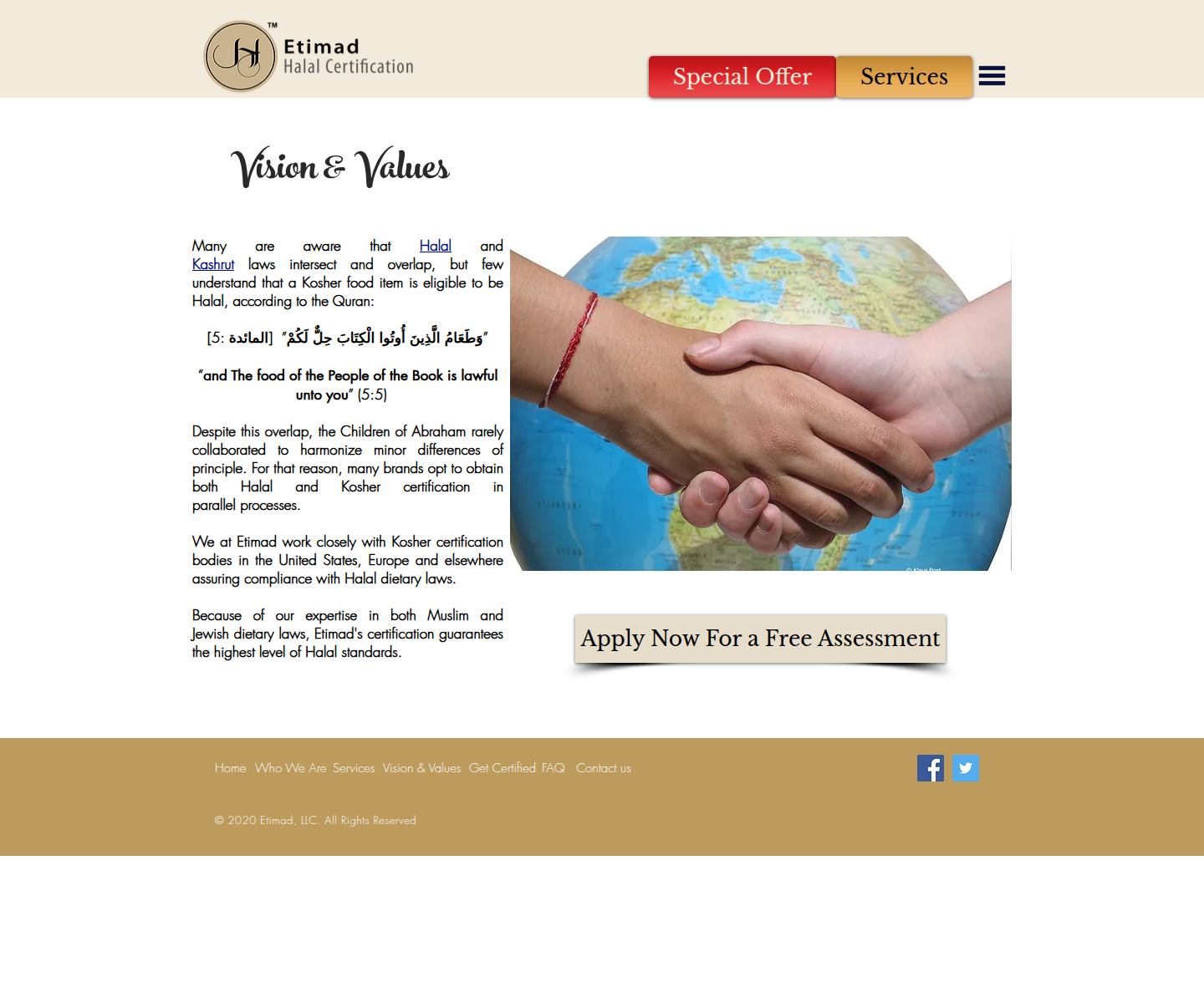
| Etimad’s archived proposition | What the cited sources actually support | Required conclusion |
|---|---|---|
| A kosher food item is eligible to be halal under Qur’an 5:5 | Ibn Kathir discusses qualifying slaughtered animals of the People of the Book, not every kosher-certified product | Kosher status never establishes halal status by itself |
| Kosher and halal laws overlap | Some animals, slaughter concepts, and food controls overlap, while alcohol, ingredients, equipment, handling, and other rules differ | Every applicable halal requirement still needs its own evaluation |
| Etimad works closely with kosher certification bodies | Coordination can transfer documents or reduce administrative duplication | Coordination cannot transfer halal religious authority or replace the halal audit |
Etimad’s current process page still does not show how auditing is done
Etimad’s current Services page says that every ingredient and processing method must be fully verified as halal compliant [26]. That is the right standard to state. But the page publicly shows only three steps: application, agreement, and certification. It does not identify an audit stage, a method for observing facilities, a halal auditor, a technical reviewer, religious decision authority, a written report, or an independent certification committee.
This omission does not prove that these functions never happen. It does mean the current public process cannot answer the most important question raised by the EarthKosher partnership: who does the separate halal work when Etimad promises that a client will not face a duplicate audit or added site visit?
A certification body asking Muslim consumers to rely on its mark should not require them to infer the audit from a three-step sales page. It should explain the accountable method, the people qualified to carry it out, the records produced, and the authority making the final halal decision.
The promised savings raise the main accountability question
EarthKosher’s July 30, 2026 announcement promotes one coordinated process ‘without duplicate audits, added site visits, or overlapping costs.’ It says EarthKosher clients can obtain both certifications through one workflow and that Etimad works with manufacturers and their existing certification bodies to remove duplicated inspection and audit expenses [27].
The efficiency claim needs to be examined carefully. A halal audit cannot be treated as a duplicate of a kosher audit because the audits answer different religious and certification questions. Shared scheduling, documents, or travel can reduce administrative burden. Removing the halal-specific work cannot.
The joint program could work in two materially different ways. In one, qualified kosher and halal personnel take part in the same coordinated visit, apply separate standards, record separate observations, and send the halal evidence through Etimad’s own religious review and certification decision. That arrangement can reduce travel without removing halal scrutiny. In the other, the kosher inspector’s visit or report becomes the operative facility review for the halal certificate. That is not efficiency; it is substitution, and a kosher audit cannot satisfy the halal audit.
The announcement does not tell readers which model is used. It does not name an Etimad auditor, say that qualified halal personnel join the visit, identify halal-specific observations made during the visit, describe a separate halal report, or explain who conducts the religious review and certification decision. This analysis does not say that no halal audit occurred; it finds that the reviewed public announcement does not establish the separate halal work. Given Etimad’s 2021 statement linking kosher eligibility to Qur’an 5:5, these omissions are significant. They directly concern whether the promised savings preserve halal review or remove it.
| Published benefit | A legitimate coordinated model must still show | Unacceptable substitution |
|---|---|---|
| No duplicate audits | A complete halal-specific audit scope, observations, report, and accountable personnel | Treating the kosher audit as the halal audit |
| No added site visits | Qualified halal personnel participating during the same coordinated visit, or another documented halal observation method permitted by the governing scheme | Issuing halal approval without adequate halal-specific physical confirmation |
| No overlapping costs | Savings from shared logistics or administration while retaining the full halal review | Savings created by deleting required halal work |
| Existing certification bodies may be used | A precise record of outside evidence accepted, its limits, and what Etimad independently verified | Transferring another scheme’s conclusion into a halal certificate |
The campus cases show changes, but not who conducted the audit
The Ithacan reported that Etimad certified Ithaca College’s Kosher Korner. The report says the existing Star-K kitchen was separate, used its own products, removed recipes when kosher and halal ingredients conflicted, and sourced halal-certified chicken. These facts show halal-specific changes rather than automatic acceptance of every kosher item. The article does not identify an Etimad auditor, visit, report, or decision-maker [23].
New York’s official registry separately lists Etimad as certifier for Kosher Comfort at the University of Rochester. The establishment says it serves only halal meat and orders food that is halal and free of haram ingredients. Again, the record supports that real certification activity took place, but it does not reveal the Etimad personnel or audit trail [21].
This contrary evidence is important. It prevents a responsible investigation from saying that Etimad always treats kosher status as automatic halal approval. It does not answer the current partnership question because neither campus record explains who carried out the halal audit or how the joint no-duplicate-audit method works.
The Fresko photographs show the consumer claim, not the halal audit
Three original photographs supplied to USDHS show a Fresko prepared-food product and lunch box. A rear label identifies Fresko LLC and shows multiple kosher marks alongside an Etimad Halal mark. The front identifies a Fresh Kosher herb-grilled chicken sandwich. The outer lunch box displays the word Halal beside the kosher-marked meat-product label.
The photographs show what a consumer saw: kosher and halal signals presented together on a meat product. They do not show how Etimad reached the halal approval, which evidence and inspection records were used, who assessed halal-specific requirements, what qualifications those reviewers had, or who authorized the Etimad mark.
A label records the claim made to the consumer. It does not record the process that justified that claim.
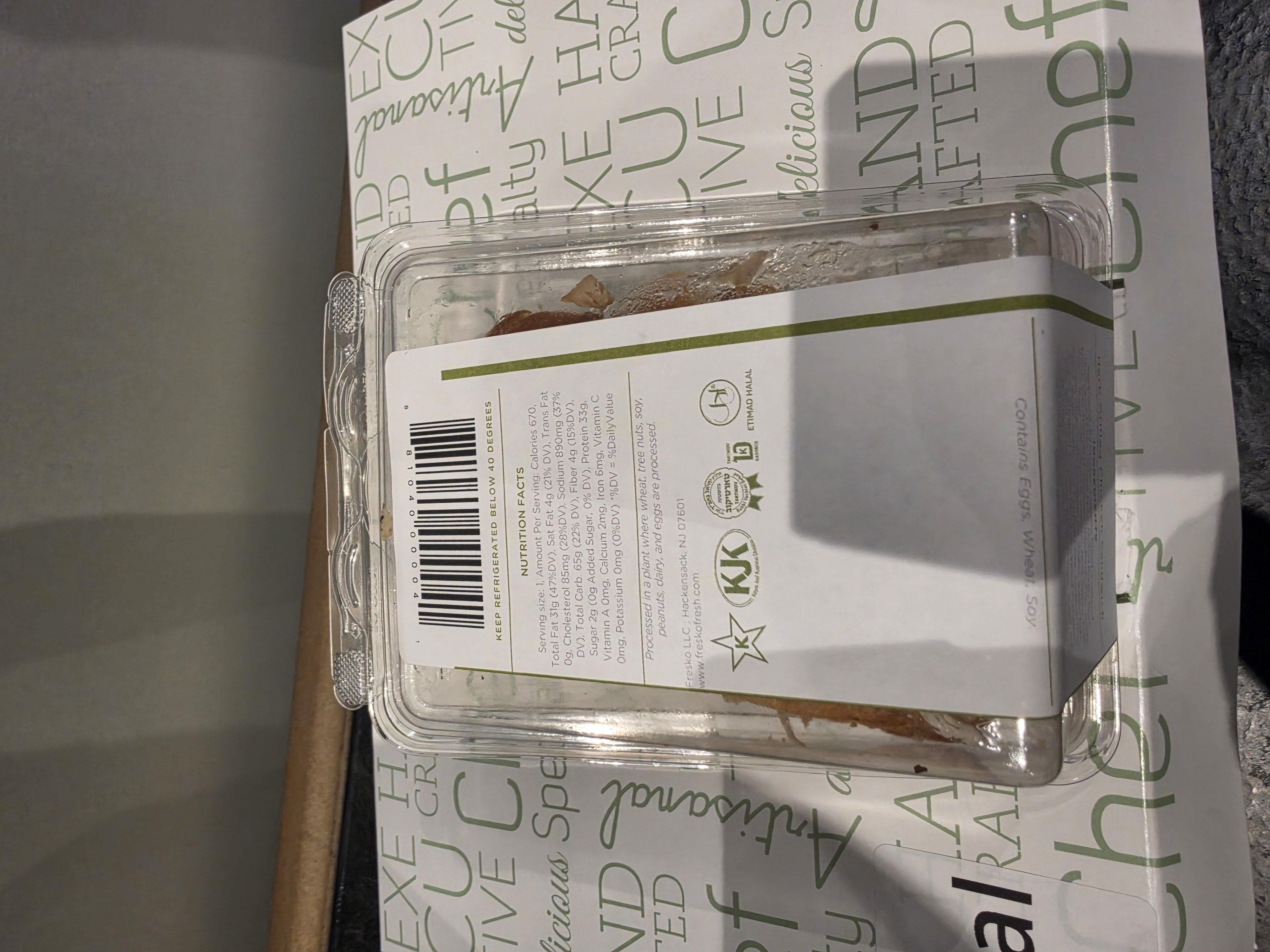
A real halal process leaves an independent chain of evidence
The public certification process cited in this investigation starts with a defined product and facility scope. It then moves through document review, a facility audit, corrective evidence when needed, technical review, and an independent certification decision. The document review covers ingredients, suppliers, processes, sanitation, traceability, and labels. The facility audit examines receiving, storage, production, sanitation, segregation, traceability, packaging, and labeling. An authorized reviewer then decides whether the complete record supports certification [37] [38].
As USDHS editorial analysis, HIPS 1002 also separates document review, physical observation, reporting, religious adjudication, and certification decision-making. Outside records may support particular facts, and some work may be coordinated, but the halal body remains responsible for competent halal review and cannot outsource its certification decision [30].
This is the distinction Etimad must make visible. A kosher certificate can be reviewed as a supplier document. A kosher inspector may record a physical fact that a halal reviewer later checks and evaluates. Neither the document nor the observation becomes the halal audit. The halal certification body must still assess every applicable halal requirement, create its own traceable record, apply qualified religious review, and retain the final decision.
USDHS guidance: do not rely on the Etimad mark alone
USDHS advises consumers, institutions, retailers, and food-service operators not to rely on the Etimad mark alone, especially for meat, poultry, animal-derived ingredients, shared facilities, and other high-risk products. Before accepting an Etimad certificate, request proof of verified 100% Muslim ownership for USDHS eligibility; the site-specific halal audit record; independently verifiable identity and qualifications for the halal auditor and decision-maker; the governing standard; the product and facility scope; slaughter evidence where applicable; and the date and method of facility observation.
The key questions follow directly from the program’s advertised benefits. Who performed the halal audit? Did qualified Etimad personnel take part in the coordinated visit? Which observations were halal-specific? What separate report was produced? Which outside records were reused, and what did Etimad independently verify? Who conducted the religious review? Who made the final certification decision?
This is not a statement that every Etimad certificate is invalid, or that Etimad conducted no halal audit in every file. The public record shows real certification activity and reported halal-specific adjustments. The documented concern is that Etimad’s archived rationale was unsupported and too broad when extended to all kosher foods, while its current partnership promotes the removal of duplicate audits and added visits without publishing the separate halal work that would make those savings acceptable.
Until that evidence is available, the Etimad mark should not be treated as a sufficient standalone signal for high-risk products. The ownership requirement is unmet on the present record, and the people exercising claimed halal authority cannot be meaningfully examined through the public record. Efficiency does not excuse an undisclosed halal audit; it makes disclosure of the owners, responsible people, audit, religious review, and decision more important.
What Etimad publicly says about its certification rules and positions
This disclosure review asks a separate question from accreditation: can an ordinary consumer identify the standard or scheme, its current version, the approving authority, and the material halal positions governing this body’s certifications? The public material is fragmented, stale, hard to find, or not enough to determine the complete current position.
The reviewed sources do establish the following about governing documents, scope, and certificate communication: Etimad certifies foods, food contact materials, cosmetics, personal care products, pharmaceuticals, and food ingredients, and it provides a public certificate-verification portal [53] [50].
The reviewed sources do not disclose enough to classify the following questions confidently: a specific governing standard or criteria manual on the official website; a standard version or effective date; a specific madhab or religious basis; supplementary schemes and their order of precedence; or how positions are communicated at certificate level. This records a limit in the public evidence; it does not prove that the body has no internal rule.
The reviewed sources also do not disclose enough to classify the following questions confidently: a position on mechanical poultry slaughter; a tasmiyyah rule for mechanical lines; a position on stunning and reversibility; criteria for alive-at-cut control; a minimum vessel requirement; or requirements for the slaughter person and supervision. This records a limit in the public evidence; it does not prove that the body has no internal rule.
For ingredients and the production environment, the reviewed sources establish that pork and byproducts from animals not slaughtered in an Islamic manner are forbidden, and that all forms of alcohol are strictly forbidden [53].
The reviewed sources do not disclose enough to classify the following questions confidently: specific criteria for processing aids and ingredient sources; controls for shared lines and cross-contact; or sanitation or ritual-cleansing methods. This records a limit in the public evidence; it does not prove that the body has no internal rule.
This review considers whether a position is publicly understandable, not whether it is the strictest position. A disclosed position within a recognized scholarly range is not penalized simply because another body follows a different view.
What evidence could change the remaining findings
This section describes the evidence that could support a higher score for Etimad Halal. It does not mean that a control is absent simply because the reviewed public record did not establish it. A submission must match the exact assessed entity, identify its dates and scope, and show who was responsible for implementation and decision-making.
Qualifying records may be public or submitted privately through the secure evidence pathway. Private records may support assurance about controls or operations when they can be authenticated, but they do not create credit for public transparency unless the organization makes the material information public.
- Metric 1 — Legal identity and operating status: Provide a current authoritative registry or regulator record for Etimad Halal that shows the exact legal name, entity number, jurisdiction, formation date, active status, operating name, and any required certification-business registration not already established.
- Metric 2 — Ownership and control: Provide a current authoritative ownership filing or authenticated controlled record for Etimad Halal identifying beneficial owners, ownership percentages, voting or governance rights, controlling persons, related entities, and conflict controls for the exact assessed entity.
- Metric 3 — Governance and accountable leadership: Provide a current Etimad Halal governing-body roster and organogram identifying accountable leaders, their roles, appointment or authority basis, management responsibilities, and entity-level accountability for certification decisions.
- Metric 4 — Personnel competence and authorization: Provide a current Etimad Halal personnel roster or independently assessed controlled record that identifies auditors, technical experts, reviewers, contractors, qualifications, sector experience, halal and audit training, authorization scope, assignments, monitoring, and competence review.
- Metric 5 — Islamic authority and halal decision: Provide current Etimad Halal records identifying Islamic-affairs experts or the decision body, their qualifications, appointment, jurisprudential basis, review responsibility, entity-level authority, and traceable participation in final halal decisions.
- Metric 6 — Halal audit method and facility verification: Provide a current controlled Etimad Halal audit procedure and corroborating recent files showing application and scope review, ingredient and process evaluation, on-site work, halal-specific observations, findings, corrective actions, reports, surveillance, and recertification.
- Metric 7 — Impartiality and decision separation: Provide a current Etimad Halal impartiality and decision-separation policy, together with implementation records, identifying conflict review, separation from consultancy, oversight membership, and separation among audit, technical review, Islamic review, and certification decision.
- Metric 8 — Standards, scheme, and certification scope: Provide a current Etimad Halal standard or scheme record identifying its version, effective date, covered sectors and locations, exclusions, supplementary schemes, precedence rules, certificate scope, and responsible issuing entity.
- Metric 9 — Public certification criteria and position disclosure: Provide a current public Etimad Halal declaration or equivalent methodology covering the governing standard and version, religious basis, scope and exclusions, practical halal positions, supplementary-scheme precedence, certificate communication, and public verification route.
- Metric 10 — Certificate traceability and mark control: Provide a current public Etimad Halal certificate directory or verification method showing the certificate identifier, holder, site, products or scope, effective and expiry dates, live status, suspension or withdrawal, and enforceable controls on mark use and misuse.
- Metric 11 — Complaints, appeals, and corrections: Provide a current public Etimad Halal complaints, appeals, and corrections procedure identifying submission routes, acknowledgement and response timing, independent review, records, re-examination, corrective action, and non-retaliation or equivalent fairness protections.
- Metric 12 — Operating history and demonstrated capacity: Provide current independently verifiable Etimad Halal operating records showing its timeline, active clients or certificates, sectors and locations served, workload, surveillance activity, and competent personnel capacity matched to that workload.
Corrections, appeals, and claiming this certification body
Etimad Halal or another affected party may submit responsive records through the secure documentary-evidence form. Material evidence is evaluated under the same methodology whether it raises or lowers the Credibility Score.
An authorized representative may also use Claim this certification body. The claimant must document their identity, role, and authority to act for the exact assessed entity. That authority must be verified through qualifying documentation and an independently confirmable official contact channel. A claim remains private and pending until it is reviewed; it does not give editorial control, disclose other submissions, or automatically change an article, Credibility Score, Grade, or ranking.
A correction request should identify the exact entity, statement, metric, source, effective dates, scope, responsible people, and requested correction. Publication does not depend on a response, and no organization has a private veto over a documented finding.
Frequently asked questions
Why does Etimad receive a 31% Credibility Score and Grade F?
The assessment looks closely at accountable leadership, qualified personnel, Islamic authority, and the ability to carry out halal-specific audits. The record shows certification activity, a repeatedly printed administrator name, sample certificate scopes, and some halal-specific adjustments. But the owners are not publicly identified; Etimad is not verified as 100% Muslim-owned under USDHS policy; the person behind the name Jamal Saleem is not independently established; and the reviewed record does not sufficiently substantiate qualified auditing, Islamic review, decision-making, impartiality, accreditation, certificate-status control, or complaint systems.
Is Etimad verified as Muslim-owned, and is Jamal Saleem’s identity and role verified?
No. The reviewed record does not identify Etimad’s beneficial owners or ownership percentages. Etimad is therefore not verified as 100% Muslim-owned and does not meet USDHS ownership eligibility on the present record. Certificates repeatedly print the name Jamal Saleem, but no reviewed biography, professional record, qualification, appointment, assignment, or authority document independently establishes the person-specific evidence required for that role.
Does the combined EarthKosher program prove that Etimad does no halal audit?
No. A coordinated visit can still preserve complete halal-specific work. But the public announcement does not identify Etimad’s qualified halal personnel, separate observations and report, Islamic review, or final certification authority. The reviewed public record therefore does not demonstrate independent halal work.
Does Qur’an 5:5 make every kosher-certified product halal?
No. The cited tafsir concerns qualifying slaughtered animals of the People of the Book, not every kosher-certified food. Kosher wine is a direct counterexample. Every applicable halal requirement still needs its own evaluation.
Is Etimad currently accredited?
This review could not verify qualifying current independent accreditation for this organization across the reviewed recognized authorities. That limited finding does not prove that no credential exists anywhere. Etimad may provide a current credential with the issuer, authority tier, dates, standard, locations, scope, and restrictions for rescoring.
References
- Etimad Halal, Who We Are
- Etimad Halal, Services
- GCC Accreditation Center, Accredited Bodies
- USDA Foreign Agricultural Service, CICOT U.S. Foreign Halal Certification Bodies for 2025–2028
- LFA Machines DFW, Etimad certificate dated April 30, 2020
- C.A.L. Italia, Etimad certificate dated October 12, 2022
- Special DM, Etimad facility certificate dated June 27, 2025
- West Penetone, Etimad certificate dated May 8, 2026
- EarthKosher, Combined Kosher and Halal Certification
- Verisign RDAP, etimadhalal.com
- Delaware Division of Corporations, Registered Agents
- Public federal bankruptcy service list linking Jamal Saleem and Etimad, LLC
- ANAB, Directory of Accredited Organizations
- Halal Accreditation Agency of Türkiye, Accredited HCABs
- Emirates International Accreditation Centre, Directory
- MUIS, Recognized Foreign Halal Certification Bodies
- JAKIM, Recognized Foreign Halal Certification Bodies, effective January 30, 2026
- USDA Foreign Agricultural Service, Indonesia’s Foreign Halal Body Recognition Context
- New York Department of Agriculture and Markets, Halal Certifier Registrations
- Etimad certificate identifying Jamal Saleem as Halal Administrator
- The Ithacan, Kosher Korner gains halal certification
- Internet Archive, Etimad Vision & Values, May 17, 2021
- Etimad Halal, Who We Are
- Etimad Halal, Services
- EarthKosher, EarthKosher and Etimad joint certification announcement
- EarthKosher, What Is Halal and Kosher Certification?
- EarthKosher, Kosher Certification Process
- USDHS, HIPS 1002:2026 Halal Certification Bodies
- Halal Watch, Halal vs. Kosher
- Verisign RDAP, etimadhalal.com domain record
- EarthKosher, About EarthKosher
- Halal Watch, Certification Methodology & Analysis Report (PDF dated 2023)
- Quran.com, Ibn Kathir Tafsir of Al-Ma’idah 5:5
- American Halal Foundation, Is Kosher Halal: Can Muslims Eat Kosher?
- Halal Watch, Halal Certification Process: From Scope Review to Decision
- Halal Watch, Halal Certification Requirements & Audit Preparation
- LFA Machines DFW, Etimad product certificate dated April 30, 2020
- C.A.L. Italia, Etimad certificate for Tersano dated October 12, 2022
- Special DM, Etimad facility certificate dated June 27, 2025
- West Penetone, Etimad certificate dated May 8, 2026
- Delaware Division of Corporations, List of Delaware Registered Agents
- A Registered Agent, Inc., Delaware registered-agent and virtual-office services
- Quran.com, Al-Isra 17:36
- Quran.com, Al-Hujurat 49:6
- Ibn Hajar al-Asqalani, Nuzhat al-Nazar — unnamed and unknown-in-identity narrators
- Ibn Hajar al-Asqalani, Nuzhat al-Nazar — unknown-status narrators and suspended judgment
- USDHS, Accreditation eligibility for halal certification bodies
- FAQ | USA | Etimad Halal Certification
- Etimad Halal Verify Certificate
- Etimad Halal Homepage
- Vision & Values | Etimad Halal Certification
View the controlling HIPS publication