
One workflow. Two religious certificates. One unanswered accountability question.
EarthKosher and Etimad Halal announced a combined kosher-and-halal program in July 2026. The announcement promises one coordinated process ‘without duplicate audits, added site visits, or overlapping costs.’ It says EarthKosher clients can be evaluated for both certifications through one workflow and one point of contact, and that Etimad works with manufacturers and their existing certification bodies to remove duplicated inspection and audit costs [1].
That is a specific efficiency claim. It is not proof that kosher certification automatically becomes halal. EarthKosher separately says the honest answer to whether a kosher-certified product is automatically halal is no. Its explanation says the systems overlap but remain separate operational reviews with different standards [2].
The public record therefore raises a narrower and more important question: when the second site visit and duplicate audit are removed, who performs and controls the halal-specific review? This investigation reviewed current and archived first-party pages, three original product photographs supplied to USDHS, Circle H's public materials, and HIPS 1002. The evidence shows process consolidation and co-displayed marks. It does not disclose enough to determine who inspected the photographed facility for halal, whether an Etimad representative attended, which audit records were reused, or who made the halal decision.
Etimad's archived statement began with kosher eligibility
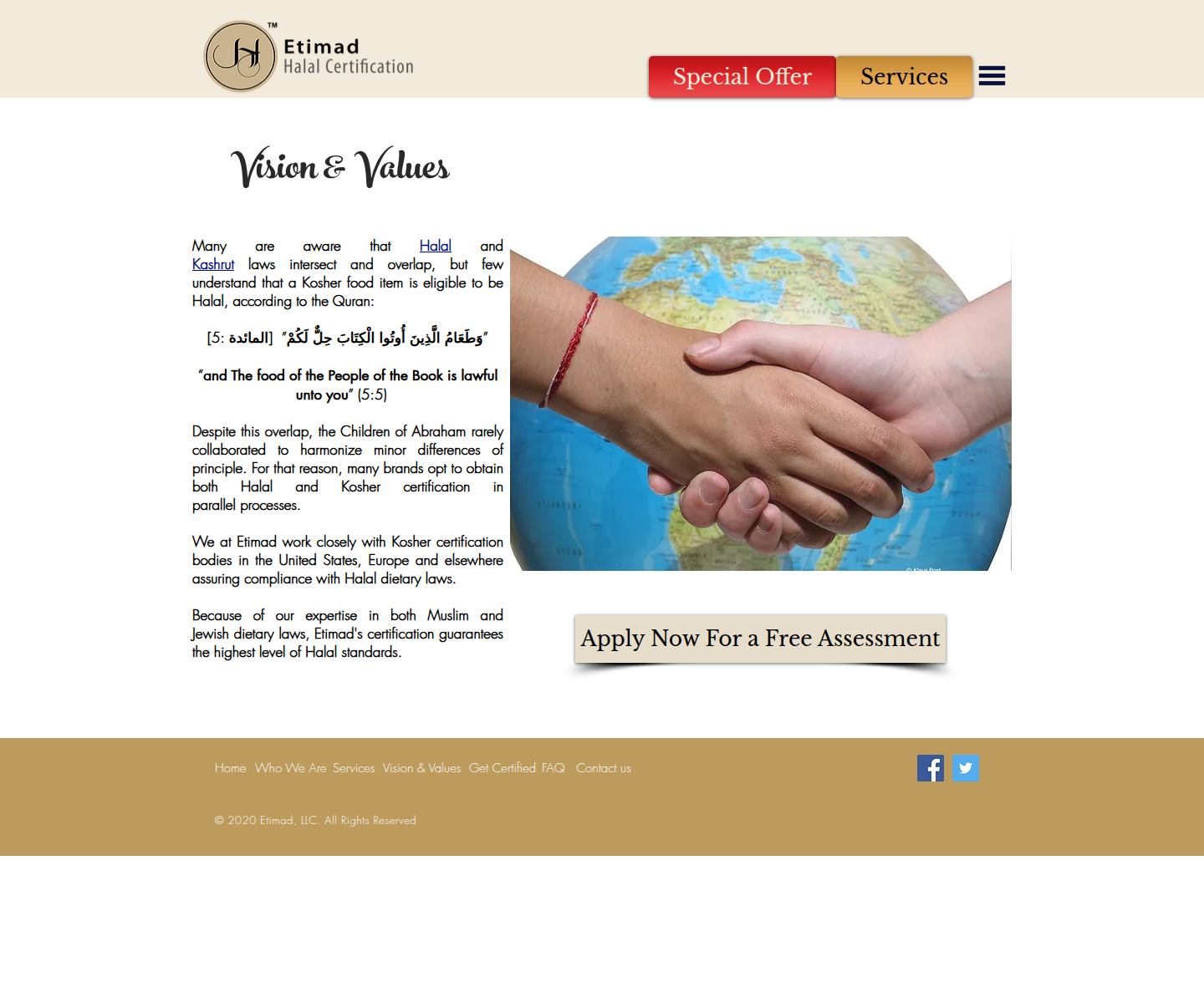
An Etimad Vision & Values page preserved by the Internet Archive on May 17, 2021 stated that halal and kashrut laws overlap and that ‘a Kosher food item is eligible to be Halal, according to the Quran.’ The page cited Qur'an 5:5, said brands often obtain halal and kosher certification in parallel processes, and added: ‘We at Etimad work closely with Kosher certification bodies in the United States, Europe and elsewhere assuring compliance with Halal dietary laws’ [3].
The word eligible matters. Eligibility means a product may qualify after the applicable halal requirements are applied. It does not mean that every kosher product is halal or that a kosher certificate is itself a halal determination. The archived page said Etimad had expertise in Muslim and Jewish dietary laws, but it did not name the reviewer, auditor, Sharia authority, certification committee, or facility-visit method.
Etimad's current Vision & Values page no longer displays that 2021 passage. Its current Who We Are page identifies the operating entity in the footer as Etimad, LLC, refers generally to a diverse team of professionals and experts, says it partners with halal certification bodies, and claims more than 160 clients. The current pages reviewed do not name an auditor or publish the qualifications and responsibilities of the people who perform Etimad's halal review [4] [5].
The combined program removes duplicate visits but does not publish the division of work
EarthKosher's July 2026 announcement says the combined program avoids duplicate audits and added site visits, removes duplicated inspection and audit costs, and lets EarthKosher clients obtain both certifications in one workflow [1].
EarthKosher's ordinary kosher process explains that its own certification requires documentation review and an on-site inspection. It says a mashgiach, or kosher inspector, visits the production facility, and describes continuing unannounced kosher inspections focused on kosher ingredients, certificates, equipment, symbols, and facility changes [6].
If the EarthKosher site visit is the only facility visit in the combined workflow, what halal-specific observations are made during that visit? Who is competent to make them? What information is sent to Etimad? Does Etimad conduct a separate documentary review? Who decides whether alcohol, processing aids, animal-source ingredients, slaughter, equipment, sanitation, storage, and cross-contamination satisfy Etimad's halal rules?
The public announcement does not answer those questions. It refers to a worldwide network of certification specialists but does not identify the halal reviewer, their religious or technical qualifications, whether an Etimad representative joins the visit remotely or in person, or the record used to support the halal decision [1]. A Red Vines certification page uses similar process-efficiency language and likewise does not identify the halal inspector or document an Etimad visit [7].
| Published statement | What it establishes | What remains undisclosed |
|---|---|---|
| No duplicate audits or added site visits | The joint program is designed to consolidate work. | Who performs halal observations and whether any Etimad representative attends. |
| Existing certification bodies may be used | Prior certification work can inform the process. | Which records are reused and what Etimad independently verifies. |
| Kosher is not automatically halal | EarthKosher publicly rejects automatic equivalence. | The file-level controls used to preserve the separate halal decision. |
What the Fresko photographs establish—and what they cannot establish
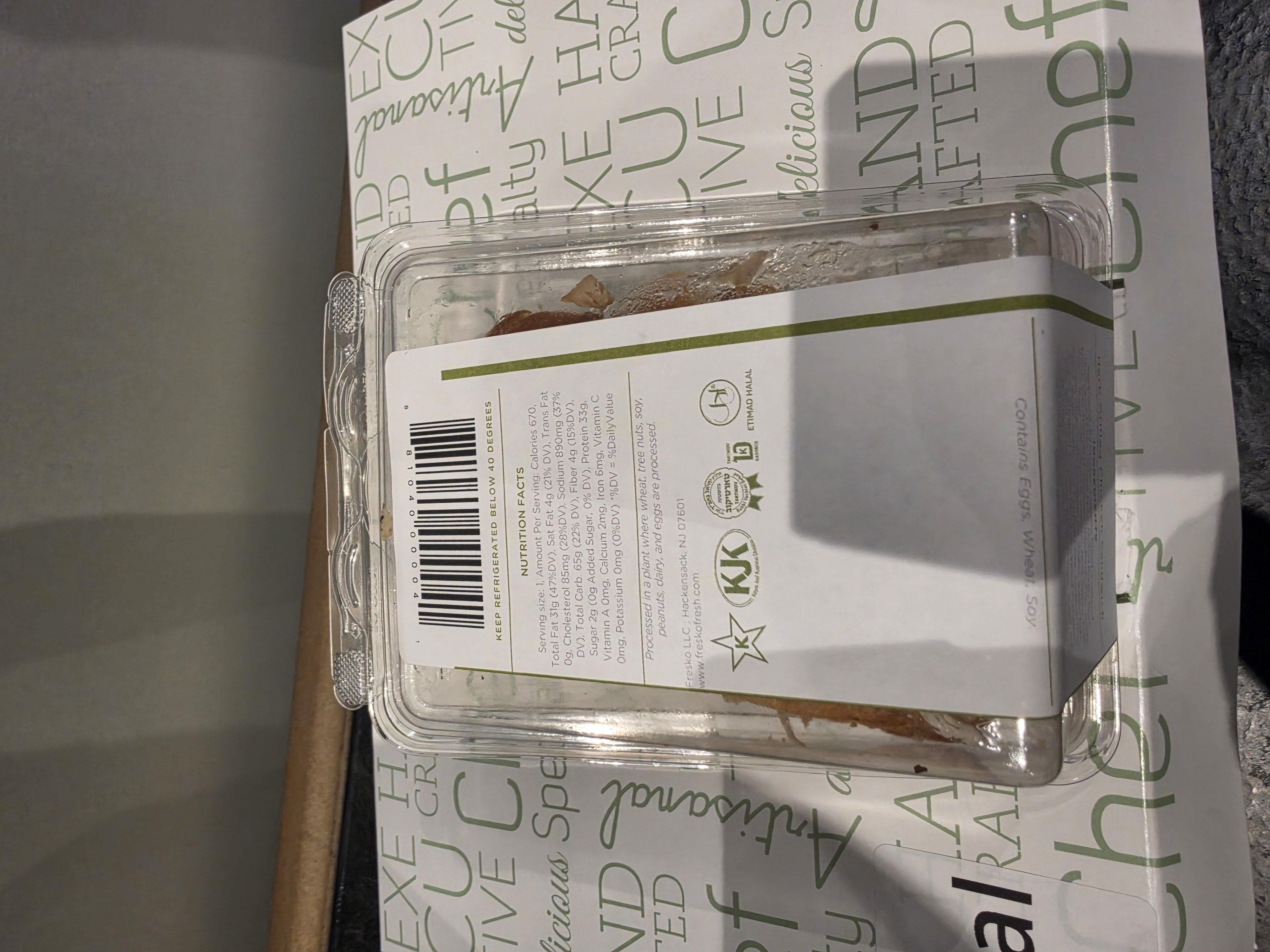
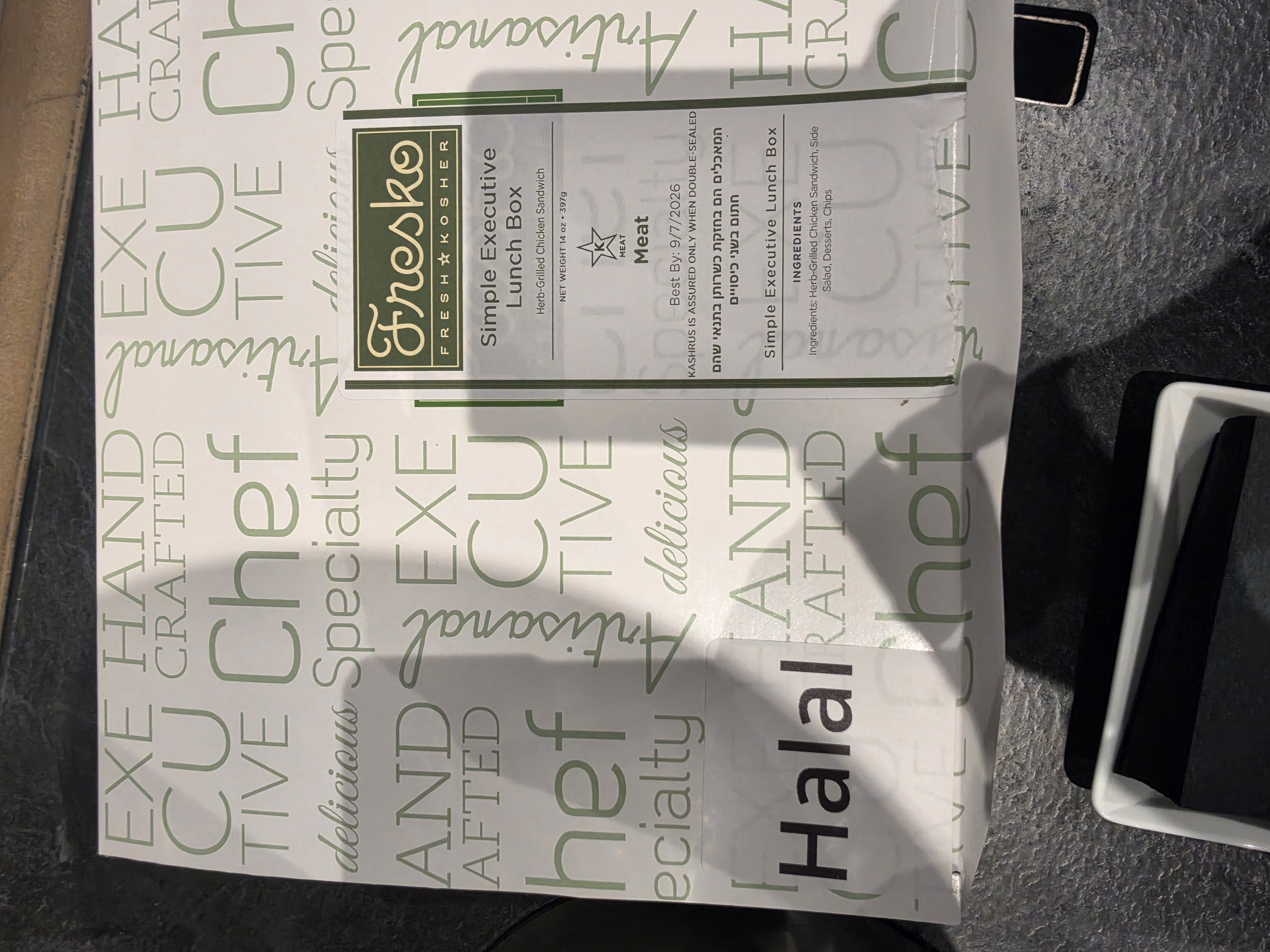
Three original photographs supplied to USDHS show a Fresko prepared-food product and lunch box. The rear label identifies Fresko LLC in Hackensack, New Jersey and displays multiple kosher marks together with an Etimad Halal mark. The front identifies a Fresh Kosher herb-grilled chicken sandwich and displays kosher marks. The outer lunch box displays the word Halal beside the kosher-marked meat-product label.
These photographs are meaningful evidence of market presentation. A consumer encountering the package sees kosher and halal signals together on a meat product. The photographs do not reveal the certification file. They do not show who visited the facility, whether qualified halal personnel or an Etimad auditor attended, whether halal observations were performed during a kosher visit, which ingredients and slaughter sources were reviewed, or who rendered the halal decision.
The correct conclusion is not that the certificate was improper. The correct conclusion is that a public mark asks the consumer to trust a process whose controlling personnel and audit trail are not explained in the materials reviewed.
The outer package makes the combined consumer signal explicit
The third original photograph shows the same prepared-food context on an outer lunch box. The word Halal is printed prominently on the package, while the attached Fresko meat-product label carries multiple kosher marks. This is additional evidence of the consumer-facing presentation, not additional evidence about inspection personnel.
The distinction is central to responsible investigation. A label can document what a consumer was told. It cannot document who entered a facility, what they observed, or how a certification body reached its decision.
Circle H presents a related transparency question, not the same evidence
Circle H International's current kosher-certification page says it works and cooperates with recognized kosher agencies, describes mutual worldwide support and development, and says the cooperation includes joint certification projects, programs, and events. It also says its mission is to meet the independent needs of kosher and halal consumers [8].
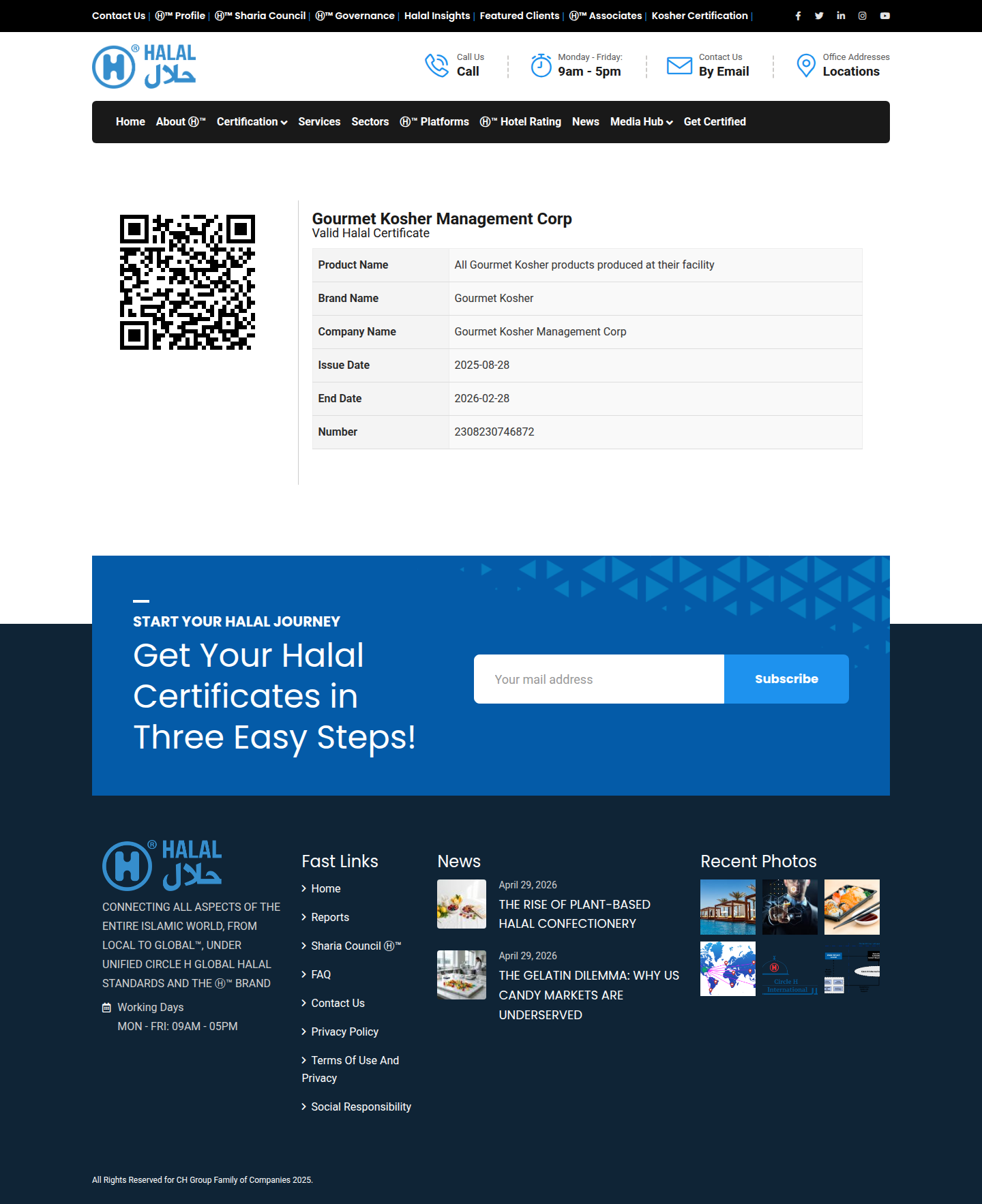
Circle H publishes a halal certificate page for Gourmet Kosher Management Corp covering ‘All Gourmet Kosher products produced at their facility,’ with an issue date of August 28, 2025 and an end date of February 28, 2026. The page displays a certificate number but does not display an auditor, inspection date, visit type, governing standard, assessor qualifications, or halal-specific findings [9].
Circle H's separate certification and compliance-assessment pages say an Assessment Team evaluates clients and prepares compliance reports. Its FAQ says halal certification applies to production sites and processes and discusses slaughter, alcohol, equipment, and contamination. Those statements are not evidence that Circle H treats kosher certification as automatically halal [10] [11].
The reported Orthodox Union link was not reproduced
The owner reported a Circle H link to the Orthodox Union. A review of current page HTML, 40 Circle H policy and report pages, Circle H's own content index, source screenshots, and available search records did not reproduce a direct ou.org or oukosher.org destination.
Circle H does publish its own Kosher Vs Halal Markets report, which discusses the Union of Orthodox Jewish Congregations and OU Kosher as market history and comparison. That is a verified OU reference; it is not evidence of an OU partnership or halal-audit substitution [12].
Circle H should therefore be treated separately from Etimad's current joint-program evidence. Its public record supports asking who audited Gourmet Kosher Management and what halal-specific review occurred. It does not support stating that Circle H accepted an Orthodox Union or other kosher audit as the halal decision.
Reusing evidence is not the same as transferring religious judgment
Certification systems often use existing records. Ingredient specifications, process-flow diagrams, sanitation records, laboratory results, food-safety audits, supplier certificates, and third-party inspection reports can reduce unnecessary duplication. The accountability issue is not whether evidence may be reused. It is whether the halal certifier remains responsible for halal-specific competence, review, observation, reporting, and decision-making.
HIPS 1002 separates those functions. It calls for documentary observation by a Reviewer and physical observation by an Auditor. It defines the Auditor as the person who observes and reports conditions from within the halal-producing facility and requires knowledge of Islamic law as applied to halal products, the production cycle, the relevant industry, audit methods, and full HIPS training. As USDHS editorial analysis of the standard, confirmation of the Halal System is typically performed through an on-site audit, although remote or document-based methods may be used where the nature and risk of the facility permit [13].
HIPS does not state that every facility must receive a second physical visit when reliable third-party evidence already exists. It also does not say that every individual Auditor must personally be Muslim. It requires demonstrable halal and Islamic-law competence, a qualified religious-adjudication function, documented work product, and an accountable certification decision. Supporting work may be subcontracted; the certification decision may not [13].
A combined process can be legitimate and efficient. The halal body should still be able to identify who performed the halal-specific review, what evidence they relied on, what they independently verified, which standard they applied, and who made the final decision.
What the current evidence establishes
The record supports precise conclusions, not a blanket accusation. The table below separates each verified item from the conclusion it cannot carry on its own.
| Verified record | What it establishes | What it does not establish |
|---|---|---|
| Etimad's 2021 archived page | Etimad described kosher items as eligible for halal and close cooperation with kosher bodies. | Automatic halal status, auditor identity, or facility-visit method. |
| EarthKosher's 2026 joint-program release | One workflow is marketed without duplicate audits or added site visits. | Who performs halal observations or makes Etimad's decision. |
| EarthKosher's 2026 explainer | EarthKosher expressly says kosher is not automatically halal. | The detailed controls used in each combined-program file. |
| Three Fresko photographs | Kosher and Etimad or halal signals appear together on the photographed meat product and packaging. | Who inspected, what was reviewed, or whether an independent halal visit occurred. |
| Circle H's cooperation page and certificate | Circle H describes kosher-agency cooperation and certified Gourmet Kosher Management products. | An OU partnership, automatic halal acceptance, or substitution of a kosher audit. |
| HIPS 1002 | A halal body must own qualified review, observation, reporting, and the certification decision. | That every halal scheme must use the same personnel or require two physical visits. |
Questions the named organizations can answer
Etimad, EarthKosher, Circle H, Fresko, and Gourmet Kosher Management can resolve the public-record gaps with documentary answers. Relevant material includes audit plans, attendance records, qualifications, halal-specific reports with confidential commercial information redacted, governing standards, certification-committee records, ingredient or slaughter-source controls, and documented scope and dates.
- For the photographed Fresko products, what facility and certificate scope were in force, and who performed the halal-specific review?
- Did an Etimad representative visit the facility? If not, which inspection records were reused and what additional halal review occurred?
- What qualifications did the halal reviewer and final decision-maker hold, and what religious authority governed disputed questions?
- Which ingredients, processing aids, animal sources, slaughter records, equipment, sanitation, storage, and contamination controls were reviewed for halal?
- Does Etimad maintain a written rule defining when a kosher-certified product is eligible for halal certification?
- For Circle H's Gourmet Kosher Management certificate, who conducted the assessment, when did it occur, and what standard and report supported the decision?
- Which named kosher agencies participate in Circle H's joint certification projects, and what work does each party perform?
- Which Circle H page contained the owner-reported Orthodox Union link, and what proposition did the destination support?
A documented opportunity to respond or correct the record
USDHS invites Etimad, EarthKosher, Circle H, Fresko, and Gourmet Kosher Management to provide documentary clarification through director@halalstandards.org. Material responses will be described fairly, and substantive corrections will be dated. Confidential commercial information may be redacted if the remaining document permits the relevant process and responsibility to be verified.
This article does not accuse any named organization of fraud, dishonesty, profiteering, illegality, or bad religious intent. It does not declare any certificate invalid. It does not state that Etimad or Circle H conducted no halal review. It reports what the cited organizations published, what the photographed labels show, what the reviewed pages do not disclose, and what evidence would answer the remaining questions.
Protect the halal industry by preserving an accountable halal decision
Efficiency and integrity are not opposites. A halal body can use reliable third-party records without asking the public to accept an unexplained transfer of authority. The safeguard is a traceable halal-specific file: named competent roles, declared standard, documented observations, transparent scope, responsible decision-maker, and a correction path.
Kosher certification is not halal certification. The systems may overlap, and a kosher-compliant product may be eligible for halal certification, but eligibility is the start of a halal determination—not its substitute. Protecting the halal industry means making that distinction visible and verifiable.
This article provides public-record research and general educational guidance. It does not replace the controlling HIPS standard, a certification or accreditation decision, a legal opinion, a religious ruling, or direct verification of an individual certificate.
Frequently asked questions
Does Etimad say every kosher product is automatically halal?
No. The archived Etimad page said a kosher item is eligible to be halal, and EarthKosher's current explainer expressly says kosher certification is not automatically halal. The investigation concerns how the combined program performs and documents the separate halal review when duplicate audits and added site visits are removed.
Do the Fresko photographs prove that Etimad relied only on kosher auditors?
No. The photographs establish that the visible product and packaging carried kosher and Etimad or halal signals together. They do not identify the auditor, site visit, records reviewed, or certification decision.
Did USDHS verify a Circle H link to the Orthodox Union?
No direct OU-domain link was reproduced in the current pages and records reviewed. Circle H publishes its own report discussing the Orthodox Union and OU Kosher as market history. That reference does not establish a partnership or audit substitution.
Does HIPS require two separate site visits for combined certifications?
Not categorically. HIPS requires the halal body to own qualified halal review, observation, reporting, and decision-making. It permits proportionate remote or documentary methods where appropriate and allows supporting work to be subcontracted, but not the certification decision.
What evidence could resolve the central question?
An audit plan or attendance record, the halal reviewer and decision-maker's qualifications, the halal-specific report, the governing standard, the product and facility scope, and records showing how ingredients, meat sources, equipment, sanitation, and contamination were evaluated.
References
- EarthKosher, EarthKosher Partners with Etimad Halal, July 9, 2026
- EarthKosher, What Is Halal and Kosher Certification?
- Internet Archive, Etimad Halal Vision & Values, May 17, 2021 capture
- Etimad Halal, Who We Are
- Etimad Halal, Services
- EarthKosher, Kosher Certification Process
- Red Vines, Our Certifications
- Circle H International, Kosher Certification
- Circle H International, Gourmet Kosher Management Corp certificate page
- Circle H International, Certification
- Circle H International, Frequently Asked Questions
- Circle H International, Kosher Vs Halal Markets
- USDHS, HIPS 1002:2026 Halal Certification Bodies