Topics: Indonesia · BPJPH · Halal Certification · Cosmetics · Health Supplements · Chemical Products
Indonesia announces more time for selected halal requirements
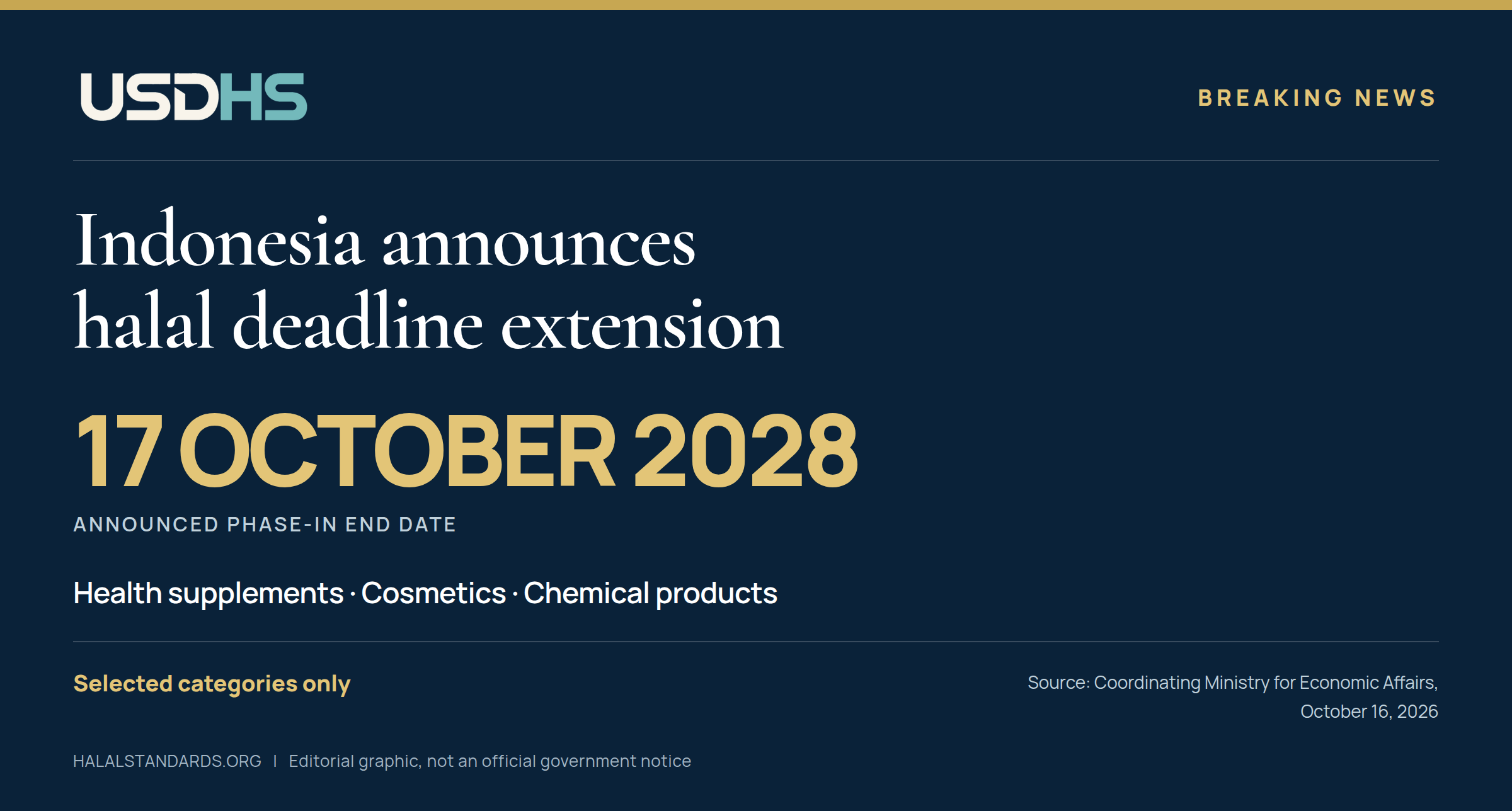
Manufacturers and exporters preparing for Indonesia’s October 2026 halal requirements have a significant new development to consider. The government has announced a two-year extension for selected product groups, including health supplements, cosmetics and chemical products. Their revised phase-in period ends on October 17, 2028, with implementation following on October 18, 2028. This is not a blanket extension of every halal requirement. [1]
Halal Standards is sharing this update following an October 16 announcement from Indonesia’s Coordinating Ministry for Economic Affairs, the Jakarta-based ministry coordinating economic policy across government. Its official press release, reference HM.02.04/361/SET.M.EKON.3/10/2026, was displayed at 20:44 Jakarta time and describes changes to the phased obligations under Government Regulation No. 42/2024. [1]
The ministry attributes the adjustment to an evaluation of the halal ecosystem’s readiness and feedback from business and industry associations. The stated aim is to give businesses and institutions more preparation time while maintaining consumer protection and supporting trade. [1]
“The phase-in period is adjusted to run until October 17, 2028.”
Original Indonesian: masa penahapan disesuaikan menjadi sampai dengan tanggal 17 Oktober 2028.
How the law reached this point: 2014 to 2026
Indonesia’s mandatory system began with Law No. 33/2014 on Halal Product Assurance, enacted on October 17, 2014. Its original Article 4 required halal certification for products entering, circulating and traded in Indonesia. Article 67 allowed five years before that obligation began and provided for phased product coverage. This was a staged legal transition, not a requirement imposed on every sector overnight. [4]
The first food and slaughter-related transition ran from October 17, 2019 to October 17, 2024. Government Regulation No. 39/2021 formed part of that rollout; Government Regulation No. 42/2024 replaced it. On October 18, 2024, the Ministry of Religious Affairs confirmed that specified food, beverage and slaughter-related groups produced by medium and large domestic businesses had entered mandatory implementation. [5]
That 2024 regulation gave micro and small businesses until October 17, 2026 for the specified groups, while foreign-origin products followed a separate timetable linked to mutual recognition. Cosmetics, supplements and certain other categories also had 2026 transition deadlines, with some medicines scheduled later. The dates differed because the system distinguished products, business sizes and import pathways. [2] [5]
Even on October 8, 2026, the Coordinating Ministry for Economic Affairs was describing an October 18, 2026 start with readiness-based implementation arrangements. Its October 16 announcement then moved the identified groups to 2028. The new statement therefore changes the announced timetable; it does not mean the original law or all obligations already in force have disappeared. [6] [1]
Which product groups move to 2028?
The announcement identifies natural medicines, quasi-drugs, health supplements, cosmetics, chemical products, genetically engineered products and specified categories of use goods. These are the groups previously assigned a phase-in end date in October 2026 under Article 161, letters (a), (d), (e), (f) and (g). [1]
The existing regulation identifies the relevant use goods as clothing, head coverings and accessories; household health supplies and equipment; Islamic worship articles; stationery and office supplies; and Class A medical devices. It limits covered use goods to those originating from or containing animal elements. Its chemical and genetically engineered product provisions concern products related to food, beverages, medicines or cosmetics, not every industrial chemical. [2]
October 17, 2028 is the final day of the announced transition period. October 18, 2028 is the following implementation date. Keeping those dates distinct matters when planning product launches, certification work and imports. [1]
Separate changes for imports, small businesses and services
The release also announces changes under Article 160. For services relating to food, beverages and slaughter products, other than slaughtering services, the obligation is to begin on October 18, 2028. [1]
For micro and small businesses producing food, beverages and slaughter products, or providing slaughtering services, the phase-in period is extended through October 17, 2028. This is a defined business-size provision, not an announcement that every domestic food producer receives a new deadline. [1]
For foreign-origin food, beverages, slaughter products and slaughtering services, the ministry announces an October 18, 2028 start, taking into account completion of mutual recognition cooperation for halal certificates. Exporters should therefore distinguish the imported-product provisions from those applying to Indonesian businesses and services. [1]
Not all medicines or existing obligations are postponed
Other schedules remain unchanged, the ministry says. Over-the-counter and limited over-the-counter medicines retain their October 17, 2029 phase-in deadline. Prescription medicines, excluding psychotropics, retain October 17, 2034. It would be inaccurate to describe the announcement as giving all pharmaceuticals a 2028 deadline. [1]
Nor does the release announce a general suspension of obligations already in force. Under the existing regulation, the transition for medium and large domestic businesses in the specified food, beverage, slaughter-product and slaughtering-service categories ended in October 2024. Businesses should check their own product category and applicable pathway rather than treating 2028 as a universal reset. [2]
Implementing rules and foreign-product verification
The government says it will align implementing rules with the amendment and revoke BPJPH Regulation No. 4/2026 on verification of foreign halal products entering Indonesia. BPJPH is Indonesia’s Halal Product Assurance Agency. The planned revocation concerns that particular instrument; it does not announce the abolition of foreign certifier recognition, certification-scope approval or every import requirement. [1]
The reviewed release describes an amendment to Government Regulation No. 42/2024 but does not provide its number or full text. Halal Standards has not independently verified that amending text or a revocation instrument. At review, BPJPH’s legal repository still listed Regulation No. 4/2026 as in force. [1] [3]
Why the government is willing to adjust the timetable
The government’s stated position is that mandatory certification must work in practice. The October 16 release cites the readiness of the halal system and feedback from business and industry associations. More time is intended to strengthen implementation, protect consumers and keep trade moving, rather than abandon certification. [1]
That approach was already visible in the October 8 statement. Deputy Coordinating Minister for Economic Affairs Dradjad Hari Wibowo said the new policy would undergo evaluation and improvement. Eight days later, ministry secretary Susiwijono Moegiarso explained the extension through an amendment to Government Regulation No. 42/2024. These are documented readiness-based decisions, not a promise that deadlines will keep moving. [6] [1]
For future planning, the distinction matters: further official adjustments are possible, but another extension has not been promised. Companies should prepare against the applicable announced timetable and verified implementing rules, not assume that 2028 will automatically be postponed again. Nor should a company already subject to certification treat this change as permission to stop complying.
“Evaluation and improvements will be carried out”
Original Indonesian: evaluasi dan perbaikan akan dilakukan
What manufacturers and exporters should do now
The announcement offers additional preparation time for the identified groups, not automatic shipment clearance. Manufacturers can use that time to confirm ingredient origins, strengthen traceability and coordinate certification with their importers. Before shipping, importers should confirm applicable implementation, product classification and certificate acceptance, including the issuing body’s recognized scope.
Read the full government announcement before planning your next steps. Its category-specific wording is more useful than a headline suggesting that all Indonesian halal obligations have moved to 2028. [1]
Frequently asked questions
Does every halal requirement now have a 2028 deadline?
No. The announcement identifies particular product groups, imports, business sizes and services. Other medicine schedules and obligations already in force are not generally reset. [1] [2]
Has the full amending regulation been independently verified?
Not in this review. The official release describes the amendment but does not give its number or full text. Importers should confirm applicable implementation before shipping. [1]
Does the extension mean the government will postpone the deadline again?
No further extension has been promised. The official statements show that implementation is evaluated against readiness, but any later change would need another official decision. The announced adjustment does not remove obligations already in force. [1] [6]
References
- Coordinating Ministry for Economic Affairs, October 16, 2026: official announcement HM.02.04/361/SET.M.EKON.3/10/2026
- Government Regulation No. 42/2024: Articles 157–161, original product scope and staged deadlines
- BPJPH legal repository: Regulation No. 4/2026, status displayed at review on October 16, 2026
- Law No. 33/2014 on Halal Product Assurance: original Articles 4, 26 and 67 and enactment date, BPJPH-hosted English text
- Ministry of Religious Affairs, October 18, 2024: first phase completed, medium/large business obligations and distinct small-business and import timetables
- Coordinating Ministry for Economic Affairs, October 8, 2026: readiness, implementation stages and evaluation policy