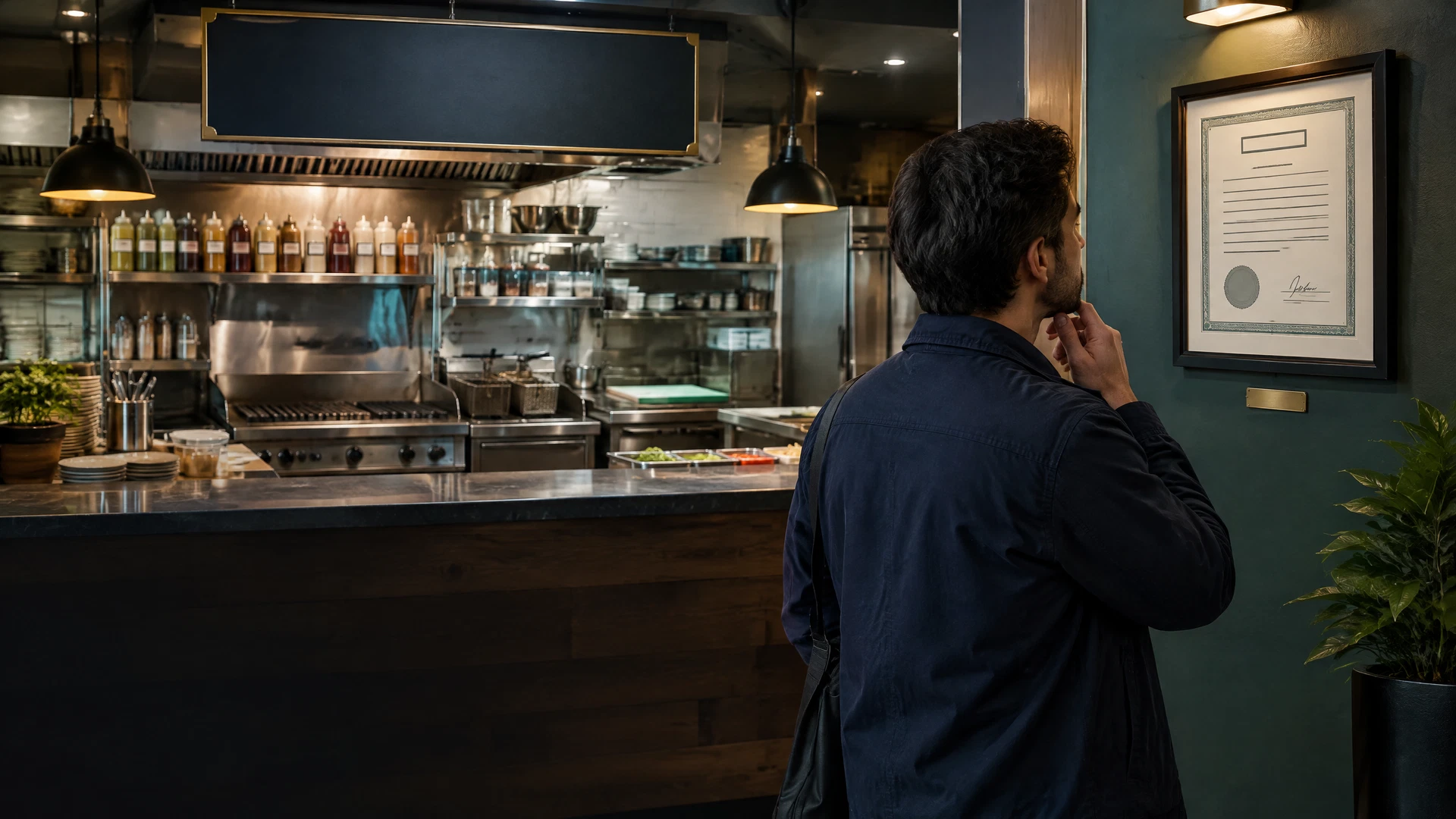
The certificate on the wall may answer a much smaller question
A restaurant can display the word “halal” on its sign, menu, delivery profile, and front window while pointing concerned customers to a certificate hanging near the register. From a distance, that document feels reassuring. It looks official, it carries dates and signatures, and it may be the only evidence a customer is shown before ordering.
But a certificate is meaningful only within its stated scope. If the document names a meat processor, distributor, or supplier rather than the restaurant where you are standing, it may support the halal status of a particular purchased ingredient. It does not, by itself, certify the restaurant, its entire menu, or the work taking place behind the counter.
That distinction is not an accusation. The restaurant may be buying genuinely halal-certified meat and may be following careful practices. The point is that a supplier certificate and an establishment certificate answer different questions. A halal-conscious consumer should be able to tell which question the document actually answers before relying on it.
Start with the name on the certificate
Read the certificate closely. Does the company or facility name match the restaurant? Does the address identify the premises where the food is prepared? If the names differ, ask whether one is the legal entity and the other is a registered trade name, whether the certificate belongs to a parent company, or whether it belongs only to a supplier.
A different name is a reason to ask for clarification, not automatic proof of deception. Businesses often operate under a public-facing name that differs from their legal name. A meaningful connection should still be explainable and verifiable through the certificate, its attached scope, the certifier, or public business records.
New York’s halal registration framework treats prepared food under a restaurant’s control separately from food supplied in packaged form. Restaurants representing food prepared on their premises as halal must identify the certifier and post establishment-specific registration information where consumers can see it [3]. That state requirement is not a nationwide rule, but it illustrates the practical difference between evidence about a supplier and evidence about the place preparing the meal.
A meat certificate does not cover every ingredient
Even when the certificate correctly covers the restaurant’s meat supplier, meat is only one part of many dishes. Sauces, marinades, cheese, bread, desserts, flavorings, extracts, gelatin, enzymes, frying oils, processing aids, and beverages may introduce separate halal questions. A supplier certificate says nothing about those materials unless the document or an attached product schedule expressly includes them.
The connection between the certificate and the food being served also matters. Current invoices, packaging, labels, batch information, or other traceability records may be needed to show that the restaurant is actually receiving the certified product named in the document. The American Halal Foundation’s verification guide makes the same scope point: a genuine certificate can still apply only to one facility, product line, private-label item, or batch rather than everything a company makes [4].
The basic rule is simple: a document should not be stretched beyond the business, facility, dates, and products it identifies.
The certificate may say nothing about what happens behind the counter
Restaurant-level halal assurance reaches beyond purchasing. It includes receiving, storage, labeling, preparation surfaces, utensils, fryers, grills, cooking oils, sanitation, employee practices, and controls for contact with pork, alcohol, or other materials the restaurant does not present as halal. A supplier’s certificate cannot establish those conditions because the supplier does not control the restaurant’s daily operation.
New Jersey’s consumer-protection system shows why operational disclosure matters. Businesses must disclose relevant practices, including whether food contains pork products or alcohol and whether the same or separate equipment is used for halal and non-halal food. State investigators compare those disclosures with purchase orders, freezers, preparation stations, handling, and service practices [1] [2].
Not every state uses New Jersey’s system, and a missing state form does not by itself prove that food is non-halal. The broader lesson is that meaningful establishment assurance must address the practices that can change a meal after an ingredient enters the building.
- Which ingredients and menu items are represented as halal?
- How are halal ingredients received, identified, stored, and traced to current suppliers?
- Are utensils, fryers, grills, preparation areas, and storage shared with non-halal food?
- What cleaning, separation, change-control, and employee-training practices are followed?
- Who independently reviewed those practices, and when was the most recent review?
Four checks make a certificate worth relying on
A certificate should make its authority and limits understandable. At minimum, the consumer should be able to identify the issuer, the certified business or facility, the current validity period, and the products or activities within scope. The issuer should also provide a way to confirm that the certificate is authentic and remains active [4].
For a restaurant, those checks work together. A current document from a real certification body is not enough if it belongs to another company. A matching company name is not enough if the document expired. A current establishment certificate is not enough if the scope covers only packaged meat while the restaurant presents the full menu as certified.
| What to check | What a meaningful document should show | What still needs clarification |
|---|---|---|
| Valid certifier | The full name and contact or verification path for the issuing halal certification body | Whether the issuer currently confirms the certificate and has authority for the stated scope |
| Current dates | A certificate number plus an issue date, effective period, or expiration date | Whether renewal, suspension, withdrawal, or a later replacement changed the status |
| Correct business and facility | The restaurant’s legal or trade name and the location covered | How any different name or address connects to the establishment where the food is prepared |
| Clear product and activity scope | The menu items, product categories, preparation activities, or attached schedule covered | Whether items presented as halal fall outside the listed scope |
What to ask when the names do not match
If the wall certificate names another business, begin with a neutral question: “Is this certificate for this restaurant, or is it for your meat supplier?” That wording gives staff an opportunity to explain the relationship without being accused of dishonesty.
If it is a supplier certificate, ask which products come from that supplier and how the restaurant confirms that the current deliveries match the certificate. Then ask whether the restaurant itself has been independently reviewed for ingredients, equipment, preparation, storage, and handling. If staff say the restaurant is certified under a different legal name, ask to see the certificate scope or confirm it with the issuing body.
A certifier’s official database, QR code, certificate-number search, email, or telephone confirmation is stronger than an unverified photograph or forwarded PDF. New York publishes current establishment and certifier registration resources, while individual certification bodies may offer their own verification tools [3] [4].
A five-minute check for the halal-conscious consumer
You do not need to conduct an audit before ordering lunch. You do need enough information to understand the claim being made. These basic checks can usually reveal whether the certificate is establishment-specific or merely supplier evidence.
- Read the issuer’s full name and look for a certificate number or direct verification method.
- Check the issue and expiration dates; an expired document does not establish current certification.
- Compare the certified company and facility address with the restaurant where you are standing.
- Read the scope or attached product list instead of assuming that one document covers the whole menu.
- If the certificate belongs to a supplier, ask which ingredients it covers and what separate controls apply inside the restaurant.
- When the explanation remains unclear, contact the certifier before treating the restaurant as independently certified.
What a mismatch does and does not tell you
A supplier certificate displayed in a restaurant can still be useful evidence. It may help establish that a named meat product came from a certified source, provided the certificate is authentic, current, in scope, and connected to the restaurant’s actual purchases. What it cannot do is silently expand into certification of a different company, every ingredient, every menu item, or every practice behind the counter.
The New Jersey Attorney General has made a similar caution in another context: a business’s failure to return a required disclosure statement does not necessarily mean that it offers non-halal products [1]. Consumers should apply the same discipline here. A mismatch justifies questions and verification; it does not justify a public accusation without further evidence.
If the restaurant cannot explain the document or the certifier cannot confirm it, the consumer can decide not to rely on the certification claim. That is a personal purchasing decision based on insufficient verification, not a declaration that the establishment or every item it serves is definitively non-halal.
A halal certificate should not function as decoration. It should identify a valid issuing body, remain current, name the business and facility it covers, and state the products or activities included in its scope. When a restaurant presents the entire establishment or menu as halal, the evidence should reach the establishment and practices rather than stop at the loading dock with a meat supplier.
For restaurants, HIPS 1003-B provides the facility-specific framework, while HIPS 1002 addresses the certification body’s audit, review, and decision responsibilities [5] [6]. Those controlling documents matter because responsible certification connects ingredients, people, practices, premises, evidence, and an accountable decision.
The consumer’s role is more modest but still important: read the name, check the dates, identify the issuer, understand the scope, and ask what was actually reviewed. Those few questions turn a certificate on the wall into information that can be meaningfully evaluated.
This article provides general educational guidance. It does not decide the halal status of any unnamed establishment and does not replace the controlling HIPS standard, a legal opinion, or a religious ruling.
Frequently asked questions
Does a halal meat supplier certificate make the whole restaurant halal?
No. It may support the halal status of the supplier products within its scope, but it does not by itself certify the restaurant’s other ingredients, menu, equipment, preparation, storage, handling, or daily practices.
What if the business name on the certificate is different from the restaurant name?
Ask whether the certificate names the legal entity, a registered trade name, a parent company, or only a supplier. A different name requires a verifiable explanation; it is not automatic proof of deception.
Does an expired halal certificate prove the food is not halal?
No. It means that document does not establish current certification. Current status should be confirmed with the issuing certification body or its official verification system.
Must every restaurant menu item appear on the certificate?
The certificate or an attached scope should be clear enough to identify the covered products, categories, menu items, and activities. Consumers should not assume that unlisted items are included.
What are the most important details to check?
Check the issuing certifier, certificate number, current dates, certified business and facility, and the exact product or activity scope. Then confirm the document directly with the issuer where possible.
References
- New Jersey Attorney General: Honesty and Transparency in Food Sold or Served as Halal
- New Jersey Division of Consumer Affairs: Halal Food Enforcement Frequently Asked Questions
- New York State Department of Agriculture and Markets: Halal Foods Registration
- American Halal Foundation: How to Verify a Halal Certificate
- USDHS: HIPS 1002 Certification Bodies
- USDHS: HIPS 1003-B Restaurants
View the controlling HIPS publication · View the controlling HIPS publication · View the controlling HIPS publication